Alain Delon: An Angel with the Soul of a Devil

Author
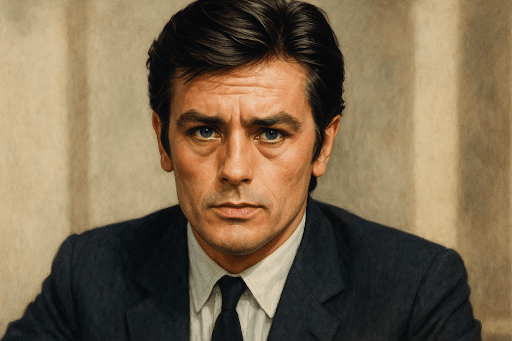
Alain Delon’s fame began with the phrase: “You’re too handsome to be an actor.” Try saying that to someone today — you’d end up in their Stories as a case study in toxicity.
From Butcher to Movie Star: The Birth of a Myth
The future style icon was born in a working-class suburb of Paris. Nothing in his childhood foreshadowed stardom: his parents divorced, and he lived with foster guardians — the caretakers of Fresnes Prison, where he once heard the gunshots that ended the life of collaborator Pierre Laval. Expelled from six schools in succession, Delon resigned himself to becoming a butcher and earned his diploma in meat cutting. His destiny, it seemed, was sealed.
At seventeen, however, he was drawn to the skies — he dreamed of becoming a test pilot. An army recruiter offered him a then-considerable 200,000 francs, and Delon joined the paratroopers, later serving in the war in Indochina. “That was the happiest time of my life. It allowed me to become who I later became,” he would recall. After demobilization, he worked as a waiter on Place Pigalle until friends persuaded him to try his luck in film. Producers waved him off: “You’re too beautiful; you’ll never have a career.”
But fate intervened in the form of Jean-Claude Brialy, and in 1956 the two went to the Cannes Film Festival hoping to be noticed. It worked. Hollywood talent scout David Selznick — then searching for a successor to James Dean — took note. Stardom in America was within reach, but French director Yves Allégret convinced Delon to stay. His advice — “Be yourself. Don’t act, live!” — became Delon’s professional creed. He often called himself “an accidental actor.”
Cinematic Genius: When Beauty Is Both Curse and Gift
At the beginning of his career, Delon’s flawless looks were more of a hindrance than a help. Yet it was precisely this beauty — combined with a rare gift for cinégenic presence, the ability to move perfectly on camera — that made him a world star. His face and body language turned even the smallest gestures — lighting a cigarette, a tilt of the head, a flick of the hand — into visual poetry. Critics dubbed him “an angel with the soul of a devil” — a paradox that became his essence, his signature.
His true breakthrough came in René Clément’s “Purple Noon’’ (1960), where Delon played Tom Ripley — a handsome young man with a child’s face and a killer’s cold, calculating soul. Audiences shuddered and fell in love. Even Clément, known for his severity, was won over: “An actor with such a perfect ear is a blessing for any director. Delon was always ready for the most incredible things.”
Next came the summit of European art cinema — Luchino Visconti’s Rocco and His Brothers. As the kind, self-sacrificing Rocco, Delon embodied the moral conscience of a doomed family. Two years later, Visconti cast him again in The Leopard, an epic saga in which Delon played Prince Tancredi. This role confirmed that he was far more than just a beautiful face: he possessed an immense emotional range. He could move effortlessly from the fallen angel Ripley to the saintly Rocco, from the saint to the aristocratic idealist.
Women, Dogs, and Solitude
Delon owed much of his uniqueness to the women in his life. It was actress Brigitte Auber who first told him, “You were made for the movies!” His life would later be filled with famous romances — Romy Schneider, Nathalie Barthélémy, Mireille Darc, Rosalie van Breemen.
He called Romy Schneider “the love of my life.” Their romance became legendary, and their joint film — ‘’The Swimming Pool’’ (1969) — a timeless icon of style. Yet even she could not anchor him. He admitted he had never met a woman he could live with until the end. His marriage to Nathalie ended in a highly publicized divorce, after which Delon vowed never to marry again: “I didn’t want to repeat my parents’ fate.”
His truest, most loyal family became his dogs. His estate in Douchy resembled a kennel. His solitude and his longing for unconditional loyalty — which he found only in animals — are the key to understanding his complex nature.
A Legend in Life: Farewell Without Illusions
In his later years, Delon deeply mourned the loss of friends and colleagues. He confessed that he could no longer watch ‘’The Swimming Pool’’: “To hear Romy say, ‘I love you,’ knowing she’s gone — I just can’t bear it.”
He spoke about aging without embellishment, with a bitter cynicism:
“Getting old sucks! General de Gaulle said, ‘Old age is a shipwreck.’ And he was right.”
In 2019, after suffering a stroke, Delon openly voiced his support for euthanasia: “At a certain point, we have the right to quietly get the hell out.” The statement was as provocative and uncompromising as his entire life.
The Man as Symbol
Delon was never an intellectual actor like Depardieu, nor did he consider himself a master of transformation. He became an icon on the opposite side of talent — like Greta Garbo or Marilyn Monroe. His charisma, mystery, and cinematic magnetism achieved what neither craft nor training could: he became an archetype.
On August 18, 2024, Alain Delon — a legend of world cinema, a recognized sex symbol, and one of the most iconic Frenchmen of the 20th century — passed away at the age of 88. A year later, his name still resonates alongside those of Charles de Gaulle, Napoleon, and Catherine Deneuve — as a symbol of France itself: its style, its charm, and its eternal contradictions.
He was laid to rest on August 23 in a private chapel on his estate in Douchy, beside the graves of his thirty-five beloved dogs — a final resting place he himself had chosen. In a twist of irony, even in death Delon provoked controversy: his family refused to honor his wish to have his faithful dog, Loubou, euthanized. Yet, as in life, scandals and contradictions only intensified his enigmatic aura. He always knew how to be different — and that was his greatest gift.
A year after his departure, it is clear: the world lost not merely an actor, but the embodiment of an era — a man in whom angel and devil, romantic and cynic, predator and victim, coexisted.
Alain Delon was not just cinema. He was France itself — the face of the 20th century.His final act — retreating into his garden among his dogs — was carried out in flawless style: tragic, beautiful, and proud, like all his roles.
Unfortunately, we will never watch new films starring Alain Delon again. But new posters and premieres await you on our website!
-
 CelebritiesDharmendra — An Eternal Icon of Indian Cinema
If one believed that true heroes existed only on screen, Dharmendra proved otherwise. He could be, within a single frame, both a gentle romantic and a fierce rebel, making hearts beat faster and rende...
25 Nov 2025, 14:26 -
 Movies & SeriesHow the Series "True Detective" Sacrificed the Entire Genre and Ultimately Won
"True Detective" is not about cozy murders in libraries, brilliant detectives in old-fashioned caps, or villains recognizable at first glance. This is a suicide series. It came to ritually crucify all...
21 Nov 2025, 13:05 -
 Higher EducationA Ray of Light for Students: Scholarships in Azerbaijan
A scholarship is like a unicorn: everyone talks about it, but few have actually seen one.And if they have — it was fleeting, in the fog, and they immediately doubted: “Did it even exist?&r...
21 Nov 2025, 12:53