



How the Series "True Detective" Sacrificed the Entire Genre and Ultimately Won
"True Detective" is not about cozy murders in libraries, brilliant detectives in old-fashioned caps, or villains recognizable at first glance. This is a suicide series. It came to ritually crucify all the genre’s canons on a cross mad...

Author
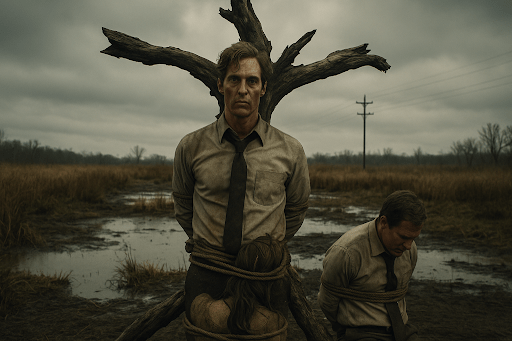
"True Detective" is not about cozy murders in libraries, brilliant detectives in old-fashioned caps, or villains recognizable at first glance. This is a suicide series. It came to ritually crucify all the genre’s canons on a cross made of swamp roots, turn them inside out, and show that true darkness is not in a killer’s actions, but in the labyrinths of our own memory. And yes, the first season is sacred scripture, while all the following ones are its apocrypha, which fans take with resistance. Why? You’ll find out now.
Spoiler: there is no detective here. Or rather, there is, but he is sacrificed in the very first episode.
If you set aside sophisticated terms like “diegesis” and “chronotope,” scholars are saying something simple: the first season of "True Detective" is not a detective story but a mythological narrative disguised as a police drama.
Everything we see is a sacrifice. A sacrifice of the genre, the plot, and the heroes themselves.
A labyrinth with no escape. At all.
Imagine that time is not a straight line from point A to point B. It is a flat circle. Everything has already happened; everything will happen again. This idea, borrowed from Nietzsche, is the main nerve of the series. The characters do not develop; they run in a closed circle, like the “lost dogs” Cole talks about.
The chronotope (space + time) here is a spiral labyrinth. Louisiana is not just a setting. It is a living, carnivorous organism. The swamps suck you in, gas pipes cut the landscape like saws, and hurricanes wash away evidence. Space here is an accomplice to the crime. In a classic detective story, there is a crime scene—a point from which logic extends. Here, there is none. There is only the point where the body is found. And where was it killed? Anywhere. Everywhere. It is a labyrinth with no center and no exit.
And this labyrinth reflects in the heroes’ minds. Rust Cole directly says: “Your whole life… — it’s all one dream you had in a locked room. A dream that you were human. And like in many dreams, a monster hides in it.”
Inside tip: the classic “locked-room murder” device is inverted here. The room is consciousness. And the killer is your own monster, a dark double who has always been with you.
Detectives as mythologists: Who is really telling this story?
Here is what is truly brilliant. Hart and Cole are not just cops. They are both actors and narrators of their own story. Everything we see in flashbacks is their subjective memory during interrogation. They are not impartial chroniclers like Dr. Watson. They are creators, mythologists. They can lie, conceal, embellish. They have power over the narrative.
That is why the formal intrigue of “who is the killer” moves to the background. What matters is not what happened, but how they interpret it. Their dialogue is not a simple exchange of lines but a battle between two philosophies: Cole’s cynical nihilism and Hart’s conservative traditionalism.
Their partnership is a classic binary opposition:
- Cole: Outsider, philosopher, nihilist. “The great detective” who hates the world.
- Hart: “One of us,” family man, part of the system. A reflection of the society he protects.
But this is only the starting point. Their true path is the destruction of these masks and the birth of new meanings through sacrifice.
Ritual suicide of a god: Why detectives must die?
Everything in this series is built on symmetry and doubling. Two detectives. Two time periods (past and present). Two murders. Two criminals. Even two climaxes and two resolutions.
This is not a pacing mistake. This is a ritual.
To defeat the monster, you must become the monster. To catch the criminal, you must go beyond the law. This is the sacrifice. In 1995, Hart and Cole, finding pedophiles, did not arrest them but enacted vigilante justice. This is the moment of their symbolic death as detective-servants of the law. They “die” in this role to “resurrect” as private individuals and then as private detectives with true free will.
Their sacrifice is twofold:
- Social: they lose status, reputation, families.
- Existential: they destroy their old selves and old value systems.
Cole is a classic “dying and resurrecting god” from myths. He voluntarily enters the lair of evil, takes a knife to the stomach, and ends up on the edge of death, where he experiences revelation—a vision of a giant spiral stretching into space, an embrace with his deceased daughter, and a sense of unity with everything he loved. He sacrifices himself and undergoes catharsis.
Hart sacrifices himself differently—he throws himself to help a friend. His reward is not cosmic epiphany, but earthly forgiveness from his family.
Key idea: the series creator, Nic Pizzolatto, was not randomly inspired by Lovecraft and Chambers’ The King in Yellow. His series is that play that drives readers mad. It infects the viewer with its pessimism, its philosophy of the flat circle, only to offer a spark of hope in the end: “Once there was only dark. If you ask me, the light's winning.”
So why does everyone hate the following seasons?
The answer is simple. Because the first season is not a detective story. It is an anti-detective. It is not about investigation, but about how the investigation serves as a pretext to talk about the eternal. Everyone wanted a continuation of the myth but got… just detectives. The second season is a corruption thriller in California. The third is a nostalgic drama about memory. The fourth is mystical horror in Alaska. They may be good in themselves (or not), but they are different. They do not sacrifice the genre, they use its established conventions.
The first season was a sacrifice. It killed the detective so that something greater—myth—could be born. The other seasons simply borrowed his clothes and tried them on.
"True Detective" is a series that went beyond itself. It used the detective shell as bait to drag the viewer into the swamp of existential horror, philosophical battles, and mythological rebirth. It proved that a true detective is not the one who solves the crime, but the one who, passing through the labyrinth of self-destruction, finds the strength to look into the eyes of their own darkness and say: “The darkness has lessened a little.”
And yes, light wins. But only after you have sacrificed everything you had.
All series become exponentially more interesting on a big screen. Check our bulletin board and pick a TV for a true viewing experience.
-
 Culinary RecipesEveryone’s Favorite Pancakes: an Interesting History and a Classic Recipe
A pancake lies on your plate—modest, golden, smelling of childhood and butter. Don’t be fooled. It’s one of the oldest gastronomic t...
23 Jan 2026, 11:24 -
 ReligionHoliday Prayer (Ṣalāt al-ʿĪd) in Islam: Structure, Symbolism, Significance
There arrives that singular dawn when the air seems to vibrate with quiet joy. Cities and villages still slumber, yet in Muslim homes lights begin to...
23 Jan 2026, 08:00 -
 ReligionBeginning the Day with Worship: On the Morning Prayer
Once, at the very break of dawn, when the world stood still in anticipation of the first ray of light, the Prophet Muḥammad (peace and blessings be up...
23 Jan 2026, 06:48