Heydar Aliyev Center: How the Project Became a Symbol of Baku

Author
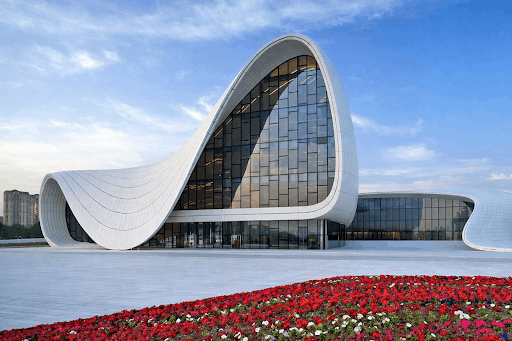
When the world first saw the sketches of the Heydar Aliyev Center in 2007, the reaction was unanimous: this was impossible. A building devoid of straight lines, resembling a frozen wave, an unfurled scroll, or a floating cloud, seemed more like the product of digital imagination than an actual architectural project.
Even seasoned engineers doubted it — how do you build something that appears to defy the laws of physics and construction logic? Yet today, this architectural masterpiece not only stands in the heart of Baku — it has become the hallmark of an entire era in Azerbaijan’s history.
An Idea Born from Legacy
On December 29, 2006, the President of the Republic of Azerbaijan, Ilham Aliyev, signed Decree No. 1886, which launched the creation of the Heydar Aliyev Center. Behind the dry wording of the document stood a serious mission: to create a space that would embody the ideas of the national leader, serve as a center for studying the ideology of Azerbaijani identity, and become a platform for dialogue between cultures and generations.
Heydar Aliyev, whose name the center bears, was more than a statesman. He was the architect of modern Azerbaijan — the person who laid the foundations of its statehood, economy, and cultural identity. And the center was not meant to be a mausoleum of memories, but a dynamic, living institution — a place where the legacy of the past would meet the challenges of the future.
The decree stated:
“...Despite extensive work carried out throughout the country within the framework of the ideology of Azerbaijani identity, it is necessary to guide this activity in a consistent and systematic way. This defines the concept of creating a multifunctional, modern Heydar Aliyev Center, which will allow citizens of Azerbaijan to participate in large-scale projects to promote their homeland, nation, and people in the context of global processes.”
In other words, from the very beginning this was not only an architectural project, but also a conceptual one. The building was meant to speak — not only about the past, but also about the future; not only about the national, but also about the global.
Zaha Hadid and Her “Seamless Flow”
The choice of architect was symbolic and bold. Zaha Hadid — the “Queen of Curves,” a genius of deconstructivism, and the first woman to receive the Pritzker Prize (architecture’s equivalent of the Nobel) — was known for her instantly recognizable projects: defying gravity, playing with forms, rejecting straight lines.
The Center in Baku became one of the key milestones of her career. “This project allowed me to take off from the ground and spread my wings,” she said. And that is felt in every line of the building. The architecture of the center embodies her philosophy of “seamless spatial flow,” where there are no boundaries between floor, walls, and ceiling; between interior and exterior; between building and landscape.
Hadid drew on Islamic architectural tradition, where ornaments and calligraphy flow from carpets to walls and from walls to ceilings, forming a continuous unified space. She brought this principle into modernity, amplified by technology and scale. The result is architecture that doesn’t simply stand on the ground, but grows from it, lives in it, and continues it.
The Engineering Challenge: Building the Impossible
If the architectural project inspired awe, the engineering challenge caused cold sweat. How do you build a 101,801 m² building rising up to 74.1 meters, without internal load-bearing walls, capable of withstanding wind and seismic loads? How do you create smooth curves that won't look like crude imitations?
Engineers conducted mathematical and computer analysis, duplicating calculations across different software systems to eliminate errors. In the end, a unique cross-beam steel tube structure was developed — a complex “skeleton” holding the entire building.
But the greatest puzzle was the outer shell. The 4-hectare roofing surface was made up of 12,027 panels — and not a single one was duplicated. Each had its own geometry — triangles, trapezoids, parallelograms — and was individually manufactured. Panels were made of fiberglass-reinforced plastic and glass-fiber concrete, materials combining strength, flexibility, and durability.
Installation resembled assembling a giant 3D puzzle: each panel was lifted by crane and then manually positioned onto the steel frame. Under the shell, 90 kilometers of metal pipes were laid, each with a unique size and position.
It was jewelry-like precision work on the scale of an entire city.
From Groundbreaking to Global Fame
Construction began on September 10, 2007, on Heydar Aliyev Avenue, on the site of the former Sattarkhan factory. For five years, thousands of workers, engineers, and architects brought the vision to life. On May 10, 2012 — Heydar Aliyev’s birthday — the Center was officially inaugurated.
And in 2014, the world formally acknowledged the project’s brilliance: the Heydar Aliyev Center won the “Design of the Year” award from the London Design Museum. The jury called it “a breathtakingly beautiful building by a brilliant architect at the peak of her career.” It was more than an award — it was a recognition that Baku had entered the club of global architectural capitals.
An Inner Universe
The Center is not just a shell. It is a complex, multi-layered organism where every function has its own space, yet everything is connected into a unified whole.
The Heydar Aliyev Museum is the heart of the complex. Three levels twisted into one volume create the effect of a vortex that “pulls” the visitor into the exhibition. The life of the leader is presented through photographs, documents, personal belongings, and multimedia installations. There is even an interactive globe: touch a country and see whom Aliyev met there and which gifts were exchanged.
The Auditorium is a 450-seat concert hall with perfect acoustics at any point. Oak panels on the walls are not just design — they create the unique sound. Concerts, forums, and film screenings take place here.
Exhibition halls — spreading across nine floors — host world-class exhibitions: from Andy Warhol’s works to “Mini-Azerbaijan,” featuring models of the country’s major architectural monuments. This is a space for dialogue between the local and the global, the traditional and the contemporary.
The Park — spanning 13.58 hectares — is an extension of the architecture. Its pathways follow the building’s curves; there are ponds, waterfalls, an artificial lake, and art objects. It is a space where architecture and nature engage in silent conversation.
Symbolism and Meaning
The Heydar Aliyev Center is a building-metaphor. Its white color symbolizes a bright future. Its wave-like lines represent the connection between past and present. Its lack of corners suggests openness to dialogue.
Some say that from above the building resembles Heydar Aliyev’s signature. Perhaps it’s just a beautiful legend, but it reflects the essence: the center has become the autograph of an era, the signature of a country on the map of world architecture.
Zaha Hadid turned the building into a manifesto of eternal movement — from earth to sky and back. It is not a frozen form, but a process, a flow, a life.
A Place Where the Future is Born
Today, the Heydar Aliyev Center is more than a landmark. It is where international forums are held, where contemporary artists exhibit their works, where music is heard — from mugham to symphonies, where children attend educational programs, and scientists discuss tomorrow’s challenges.
It has become a cultural hub, a magnet, a platform for dialogue. As Discovery presenter Danny Foster once said: “This is not just a cultural center — this is a way of asserting your place in the world.”
Indeed: through architecture, through culture, through openness and boldness, Azerbaijan has declared itself a country that does not fear the future, respects the past, and believes in the power of beauty.
The Heydar Aliyev Center stands as a reminder: the impossible is often only what has not yet been built. And with great talent and iron will, even the boldest dreams can become reality — reshaping a city, and perhaps an entire era.
-
 Family LifeThe True Superhero of Nature: The Axolotl’s Regeneration
He never truly grows up. He reproduces while still a larva. He regenerates lost organs. And he always seems to smile. Meet the axolotl—an organism that has outwitted the rules of biology and bec...
17 Jan 2026, 13:16 -
 Family LifeTahajjud Prayer: A Hidden Devotion in the Stillness of the Night
Among the many spiritual practices in Islam, the night prayer—Tahajjud—occupies a distinctive place. This voluntary form of worship, performed after the obligatory ‘Isha prayer and b...
17 Jan 2026, 12:49 -
 Family LifeMaltipoo — a Dog Designed for Happiness
Forget everything you know about dogs — none of it applies here. No service merits, no hunting talents, no noble tomes of pedigree records. That’s a whole different universe. The Maltipoo...
17 Jan 2026, 12:16