The True Superhero of Nature: The Axolotl’s Regeneration

Author
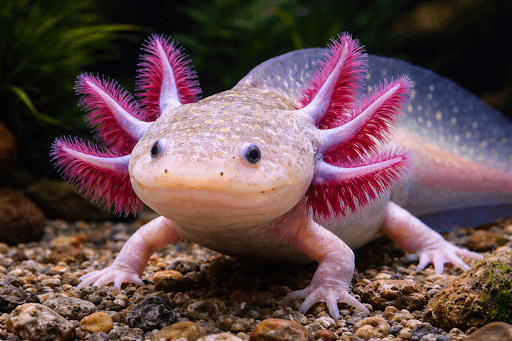
He never truly grows up. He reproduces while still a larva. He regenerates lost organs. And he always seems to smile. Meet the axolotl—an organism that has outwitted the rules of biology and become an icon of pop culture.
What if we told you that one could reach sexual maturity, produce offspring, and calmly live for fifteen years without ever becoming an adult? No, this is not the plot of a science-fiction novel. It is the everyday reality of the axolotl—an amphibian that has decided adulthood is boring and far too energetically costly.
The axolotl resembles a curious fusion of a smiling fairy-tale dragon, an extraterrestrial visitor, and an eternal adolescent. It has a wide head, tiny bead-like eyes, three pairs of feathery external gills protruding from each side like an exotic headdress, and a signature drawn-on smile. This is not the latest anime character but a real animal whose name in Nahuatl translates as “water dog” or “water monster.”
A biological paradox in numbers: the axolotl is the larval form of the tiger salamander (Ambystoma), yet it can live 10–15 years in captivity without ever metamorphosing into the terrestrial adult form. A single female can lay up to 1,000 eggs at once, and all modern domesticated axolotls descend from just 33 founders exported from Mexico in 1864.
The Phenomenon of Neoteny, or Nature’s Ingenious Laziness
The secret of the axolotl’s “eternal youth” is called neoteny, from Greek meaning “extended youth.” Its thyroid gland simply does not produce enough thyroxine—the hormone that initiates metamorphosis into a land-dwelling salamander. Why pursue the complicated and risky life on land when a clean, cool lake offers everything one needs: stable temperatures, abundant food, and safety?
Evolution’s irony is striking: while other amphibians undergo rapid and vulnerable metamorphoses (think of the tadpole), the axolotl remains in its comfortable aquatic cradle. It becomes sexually mature at roughly one year of age, bypassing all the hassles of growing up.

A Dangerous Transformation Best Left Undisturbed
Contrary to popular myths, the dormant metamorphic program can be triggered by abruptly altering environmental conditions—raising the temperature, lowering the water level, or adding dietary thyroxine. The process spans several weeks: the feathery gills disappear, the body shape and pigmentation change.
One crucial insight: this transformation is a massive physiological stress. The digestive tract may shrink by up to 70%, and the immune system is nearly reset. Most attempts to induce metamorphosis in captivity end in the animal’s death. Why risk the life of a smiling water dragon for the sake of a dubious spectacle?
The resulting salamander becomes an entirely different terrestrial organism with different care requirements. And most regrettably, it loses the axolotl’s defining superpower—its extraordinary regenerative ability.
Superhero-Level Regeneration: Beyond Limbs and Tails
If Marvel held a contest for the most impressive real-world superhero, the axolotl would win effortlessly. This organism is a master of self-repair:
- Limbs and tail: fully regrown within months
- Gills and fins: restored without scarring
- Internal organs, including portions of the heart and brain: yes, those too
- Spine: even severe spinal injuries are not a death sentence
Scientists continue to puzzle over these mechanisms, hoping one day to translate this knowledge into human medicine. Meanwhile, the axolotl simply smiles and grows back a missing limb if a tank-mate becomes overly hungry or intrusive.
Keeping Them: Less an Aquarium, More a Refrigerated Exhibit
Anyone planning to keep this “water dragon” must forget everything they know about typical aquarium fish. You are effectively signing up to operate a miniature cold-storage facility.
- Temperature is paramount: water must remain between 14–20 °C. At 24 °C, stress and fungal infections emerge. Summer care often involves ice bottles or specialized chillers.
- Space and shelter: at least 50 liters per individual. The substrate must be coarse gravel too large to swallow. Caves and shelters are essential—axolotls dislike bright light and love to hide.
- Carnivorous menu: absolutely no warm-blooded meat—their digestive system cannot handle it. Their diet consists of earthworms, bloodworms, specialized amphibian pellets, and small portions of fish or shrimp. Adults require feeding only every 2–3 days.
- Caution: individuals should be of similar size. In cramped conditions or during hunger spells, they may bite each other. Fortunately, the damage grows back—so do not panic.
Popularity and a Sobering Reality
Today, an axolotl is an internet celebrity. It appears in Minecraft, countless TikTok GIFs, and plush merchandise. It has become a symbol of all things cute and uncanny. Yet behind this façade lies a bitter truth.
In the wild, the axolotl is on the brink of extinction. It is endemic to only two Mexican lakes—Xochimilco and Chalco. Water pollution, canal drainage, and introduced predatory fish have left the species with few prospects. According to researchers, there may be as few as 50 to 1,000 adults remaining in their natural habitat.
It is a paradox: while this unique creature vanishes from the wild, its domesticated descendants thrive by the thousands in home aquaria around the world, continuing to astonish and charm people. They have become a living reminder of nature’s fragility and our responsibility toward it.
The axolotl is a kind of philosophical stone among amphibians, challenging our notions of growth, healing, and adaptability. It does not rush to mature, yet it is capable of restoring what others lose forever.
In its perpetual smile lies a quiet wisdom: perhaps happiness is not found in haste or complex transformations, but in the ability to remain oneself—even if that self is an eternally youthful “water monster.”
-
 Family LifeTahajjud Prayer: A Hidden Devotion in the Stillness of the Night
Among the many spiritual practices in Islam, the night prayer—Tahajjud—occupies a distinctive place. This voluntary form of worship, performed after the obligatory ‘Isha prayer and b...
17 Jan 2026, 12:49 -
 Family LifeMaltipoo — a Dog Designed for Happiness
Forget everything you know about dogs — none of it applies here. No service merits, no hunting talents, no noble tomes of pedigree records. That’s a whole different universe. The Maltipoo...
17 Jan 2026, 12:16 -
 Family LifeHeydar Aliyev Center: How the Project Became a Symbol of Baku
When the world first saw the sketches of the Heydar Aliyev Center in 2007, the reaction was unanimous: this was impossible. A building devoid of straight lines, resembling a frozen wave, an unfurled s...
17 Jan 2026, 11:07