Highland Park in Baku: a place where the city lies at your feet (literally)

Author
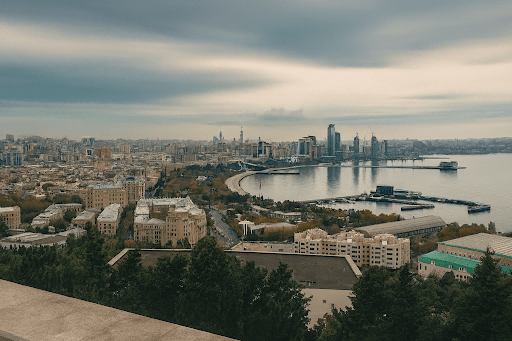
Highland Park is one of those rare corners of Baku where silence feels like a gift — something you want to protect. It’s that one place where the city suddenly stops making noise and begins to listen to itself. Each step up the staircase gently lifts you higher — to where the air is clearer and your thoughts calmer.
This park has changed its face many times: it was different in different eras, outlived people, styles, and epochs. But each time it returned renewed — like a phoenix that knows the value of its own beauty. Today, Highland Park is one of the most recognizable symbols of Baku, the place where every visitor takes their obligatory photo, because being “in Baku” without this viewpoint feels… incomplete.
And there’s something magical about that: here you can see the entire city at once within minutes — old, new, sunny, maritime. The stones of Icherisheher, the glass Flame Towers, the endless smooth expanse of the Caspian — all of it fits into a single glance. Highland Park is a walk that turns the city into a story, and the story into a breath.
It’s not just “located in the very center.” It floats above it. Highland Park is that haughty aristocrat who looks down with condescending calm at the bustle of the Seaside Boulevard, the city noise, and all that boiling life below. You live there, work there, hurry around. And he sits here, above it all — eternal and serene. And he lets you come up to take a selfie against the backdrop of his indifferent magnificence.
A park that remembers everyone
Let’s be honest. Every self-respecting park has a skeleton in its closet (or underground). Highland Park is no exception. Its history begins not with cozy benches and fountains, but with… a cemetery. Yes, right under your feet, in the thickness of that yellow limestone, lie bones. First, the victims of the tragic March events of 1918, and then British soldiers who somehow ended up here after the fall of the Russian Empire. That’s why the park received its first brutal name — the English Park.
The architect-magician
Picture architect Lev Ilyin in the 1930s. In front of him is not a park but a complicated terrain, a cemetery, and the assignment: “create a place for the cultural recreation of workers.” He looks at this mountain and sees not a problem, but potential. And what does he do? He doesn’t fight nature — he dances a waltz with it.
He creates terraces, ramps, and staircases that don’t break the landscape but embrace it. He takes local stone and builds not just pathways but white, rhythmic patterns that guide the eye straight toward the bay panorama. A genius? Undoubtedly.
Then came the Soviet period with the obligatory name of Sergey Kirov, a monument probably poking a bronze finger at the sky, and amusement rides whose creaking mixed with the whisper of the pines. And then history turned again.
In the 1990s the park became quiet and sorrowful once more — the Alley of Martyrs appeared here. The resting place of heroes of the January events and the Karabakh War. The amusements were dismantled, the noise faded. And the park found a new, respectful calm. It became sacred again — only now for the entire nation.

Rebirth from the ashes: capital renovation — Baku style
If you think “capital renovation” means painting the fence and patching the asphalt, you simply haven’t seen how it’s done in Baku. The years 2011–2013 were plastic surgery performed by a genius.
It wasn’t merely “refreshed.” It was reimagined. The old trees were preserved but integrated into a new landscape. New pathways were laid — the kind you want to walk forever. A cascade of waterfalls was built, whose murmur doesn’t drown out the silence but becomes part of it. And a modern lighting system was added, turning the park into a jeweled brooch pinned to the city’s chest at night.
The funicular that connects the park with Azneft Square is not just transport. It’s an attraction with a view of history. In 1–2 minutes (and for just a few gapiks), you travel from Soviet classicism to contemporary polish. Its capacity is thousands of passengers per day, and the number of selfies taken inside the cabins is approaching infinity.
What are you doing here? Or: instructions for using the park
- Climb. Walk up the stairs (feel like a mountaineer in the middle of a metropolis) or take the funicular (feel like a VIP). The choice is yours.
- Exhale. No amusement rides, no shouting, no hustle. Just rustling leaves, the Caspian breeze, and that very inner peace we’re all chasing.
- Look. The panorama from here is the main exhibit. It’s like a greatest-hits album of Baku’s landmarks: there’s wise old Icherisheher with the Maiden Tower; there’s the elegant Seaside Boulevard; there are the futuristic Flame Towers, which truly blaze in the evenings. And in the distance — the oily-smooth surface of the Caspian Sea. Take your phone, your camera, your eyes — shoot, absorb, remember.
- Feel. Find that stone with the hole in it. Legend has it that it cures infertility. Believe it or not — but touch it anyway, just in case. Magic, you know.
- Be silent. Walk along the Alley of Martyrs. This is not a place for loud conversations. It is a place for memory. And this memory, mixed with the incredible beauty of the living city, creates a strange, piercing feeling of pride and sadness at the same time.
A café with a philosophical subtext
There is a café in the park. But it’s not just a café — it’s a viewpoint with tables. You sit, drink tea or something stronger, nibble on sherbet, and in front of you, like a living TV screen, lies the whole of Baku. By day — bright and contrasting; by night — sprinkled with lights. It’s the most expensive and the most democratic table in the city. The price of a cup of coffee — and a million-dollar view.
Highland Park is not a dot on the map. It’s a state of being.
A state of gentle melancholy, absolute tranquility, and dizzying height. It’s a place where Baku hides none of its secrets from you. It spreads out before you like an open palm — noisy, ancient, beautiful, endlessly familiar.
Come here at sunset. When the sun dips behind the Caspian and the city lights begin to glow. Sit on the parapet. And you’ll understand why people of Baku love this place so much. It reminds them who they are. And it shows tourists why this city is worth visiting: for this view, this feeling, this eternity.
-
 Family LifeThe True Superhero of Nature: The Axolotl’s Regeneration
He never truly grows up. He reproduces while still a larva. He regenerates lost organs. And he always seems to smile. Meet the axolotl—an organism that has outwitted the rules of biology and bec...
17 Jan 2026, 13:16 -
 Family LifeTahajjud Prayer: A Hidden Devotion in the Stillness of the Night
Among the many spiritual practices in Islam, the night prayer—Tahajjud—occupies a distinctive place. This voluntary form of worship, performed after the obligatory ‘Isha prayer and b...
17 Jan 2026, 12:49 -
 Family LifeMaltipoo — a Dog Designed for Happiness
Forget everything you know about dogs — none of it applies here. No service merits, no hunting talents, no noble tomes of pedigree records. That’s a whole different universe. The Maltipoo...
17 Jan 2026, 12:16