The Woolen Aristocrat: The Whole Truth About the Persian Cat

Author
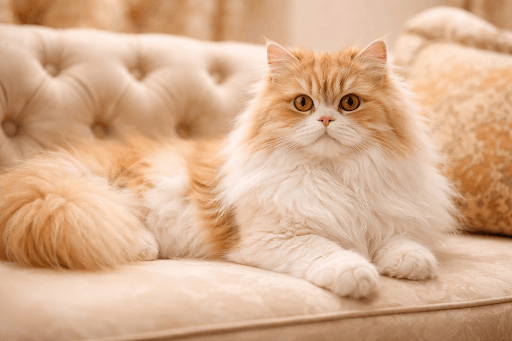
They gaze at the world with enormous, innocent eyes from calendar covers and pet food advertisements. Their face is the epitome of the feline “baby-face”: a flattened nose, a perpetual expression of mild astonishment. Yet behind this luxurious, toy-like exterior lies a centuries-long history, a personality with quirks, and a set of peculiarities that turn life with a Persian into a test of ingenuity and endurance. This is not merely a cat. This is a project. A Persian project.
From the Sultan’s Guest to the King of the Sofa
Let us reveal the cards: the Persian cat is one of the oldest and most popular breeds on the planet. Yet its path to fame was anything but straightforward. Long-haired beauties entered Europe in the 17th century not as rare curiosities, but rather as trophies—Italian aristocrat Pietro della Valle brought a handful of “Iranian cats” from a Persian bazaar. At first they were mistaken for Angoras, crossbred, and experimented upon. The aristocracy was enthralled: such a fluffy symbol of status!
The true revolution, however, occurred later, in 20th-century America. There emerged the “extreme” type—the very one with a nose seemingly pressed into the skull and eyes like saucers. Europe favored a healthier “classic” version, yet the world had already succumbed to the charm of extreme cuteness.
In the USSR, these cats appeared only in the late 1980s, brought in by diplomats—an exotic rarity accessible to very few.
Two Facial Morphologies
- Classic (European) type: the nose is relatively long and slightly upturned. The appearance is more natural and breathing issues are less pronounced.
- Extreme (American) type: the nose is markedly short, wide, often recessed. It yields a “toy-like” appearance but frequently comes with complications such as snoring, wheezing, and chronic tearing.
Beauty That Demands Sacrifice (From the Owner)
Breed standards define the Persian as a powerful and rounded creature: a cobby body with short legs, a massive round head, and small widely spaced ears. An adult male may reach 7 kg—an imposing bundle of fur upon its owner’s lap.
The primary glory and principal problem is the coat. Up to 12 cm in length, and around 20 cm at the ruff. Silky, dense, and endowed with a thick undercoat. It does not simply shed. It creates an atmosphere. You will find it everywhere: in your coffee cup, on a freshly unpacked black T-shirt, in your safe (a joke, but you understand). There are over 100 recognized color varieties—from noble chinchilla and coal black to a multitude of color-points. White Persians with blue eyes are often congenitally deaf—an unfortunate price for ethereal beauty.
And now for the famous nose. It is not merely “short and cute.” The shortened nasal septum is a product of selective breeding. Because of it, Persians snort, snuffle, and snore. It is endearing—until you hear nighttime snoring reminiscent of an aging motorcycle engine. Due to the peculiar structure of their tear ducts, their eyes water constantly. “Tear stains” on light fur are routine. A Persian owner accepts this and keeps tissues at the ready.
Temperament: Tranquility, Pure Tranquility (With a Touch of Sarcasm)
Official sources portray the Persian as the ideal homebody: phlegmatic, balanced, quiet. And indeed, this is true. The Persian is the sofa cat par excellence. It will not sprint through the apartment at 5 AM, annihilating everything in its path. Observation is its realm. It can lie for hours, staring into space or calmly tracking you from room to room.
But there is a second truth. Persians are often obstinate and strong-willed. They are not inclined to overt aggression, preferring instead to ignore those they disfavor. Yet they can exact revenge—quietly, elegantly. They demand attention in a calm and persistent manner: they will sit in front of you and gaze at your face until you surrender.
They are not afraid of children, yet they do not harbor particular fondness for them either. They coexist with other animals so long as their peace is not disturbed. They rarely raise their voice—why meow if one can simply look? And in that look resides a full spectrum of emotion—from “feed me” to “how could you.”
Do not believe the myth of utter apathy. A Persian can enthusiastically chase a ball or hunt an errant fly. Its engine simply runs briefly—and only at its own discretion.

Five Unexpected Facts About Persian Cats
- Sleepers. They may sleep 16–20 hours a day, guided by the life motto: “Movement is an unnecessary expenditure of calories.”
- Gourmets. Prone to overeating and begging. Without dietary control they swiftly become fluffy sofa-bolsters.
- Fastidious. They adore digging in the litter box. High sides are not a luxury but a necessity.
- Historical figures. Owned by Freddie Mercury, Ernest Hemingway, and Marilyn Monroe.
- Film actors. The cat in the comedy Stuart Little performed with distinction.
Care: When Beauty Requires a Daily Feat
If you believed that acquiring a Persian meant simply buying a beautiful cat, you were mistaken. You are assuming the duties of a personal groomer. The coat demands daily combing with specialized combs and brushes. Without this, it immediately mats into dense, painful clumps that usually must be cut out. Monthly bathing with specific shampoos and conditioners is obligatory.
Care involves an arsenal: combs with varying tooth widths, a slicker brush (used cautiously!), grooming talc, eye drops, ear lotion. It also demands time. A great deal of time. The Persian is a breed for those who find solace in grooming and are prepared for its meditative ritual.
Health: Knowledge Is Prevention
Selective breeding granted Persians not only unique beauty but also a bouquet of characteristic disorders:
- Respiratory system: snoring, wheezing, difficult breathing due to brachycephalic skull structure.
- Polycystic kidney disease: hereditary, particularly common in blue and cream lines; requires regular ultrasound monitoring.
- Hypertrophic cardiomyopathy: a cardiac disease difficult to diagnose in its early stages.
- Ocular issues: entropion, chronic inflammation due to persistent tearing.
Responsible breeders screen their breeding stock for genetic diseases. Ask about this when purchasing a kitten.
So Who Is the Persian Cat?
He is an aristocrat incapable of surviving on the street. A phlegmatic creature with a sense of dignity. An extraordinarily beautiful being utterly helpless without human assistance. He will not hunt mice, defend territory, or greet you at the door with your slippers. His mission is to be. To be an ornament, a living antidepressant, a silent interlocutor.
In return he asks for remarkably little: your time, your care, and a sofa by a window. Are you prepared to comb a silky mass of fur every day, to wipe tear-stained eyes, and to listen to nocturnal snuffling? If so, you obtain a fluffy fragment of history—a living work of art with a personality. A personality worth deciphering.
-
 Family LifeThe True Superhero of Nature: The Axolotl’s Regeneration
He never truly grows up. He reproduces while still a larva. He regenerates lost organs. And he always seems to smile. Meet the axolotl—an organism that has outwitted the rules of biology and bec...
17 Jan 2026, 13:16 -
 Family LifeTahajjud Prayer: A Hidden Devotion in the Stillness of the Night
Among the many spiritual practices in Islam, the night prayer—Tahajjud—occupies a distinctive place. This voluntary form of worship, performed after the obligatory ‘Isha prayer and b...
17 Jan 2026, 12:49 -
 Family LifeMaltipoo — a Dog Designed for Happiness
Forget everything you know about dogs — none of it applies here. No service merits, no hunting talents, no noble tomes of pedigree records. That’s a whole different universe. The Maltipoo...
17 Jan 2026, 12:16