The 20 Greatest Horror Films: Fear in Its Purest Form
Horror cinema is not merely about sudden “boo!” moments from around the corner. It is the domain of goosebumps, adrenaline, and the creeping sense that something terribly wrong is happening just out of sight. Let us explor...

Author
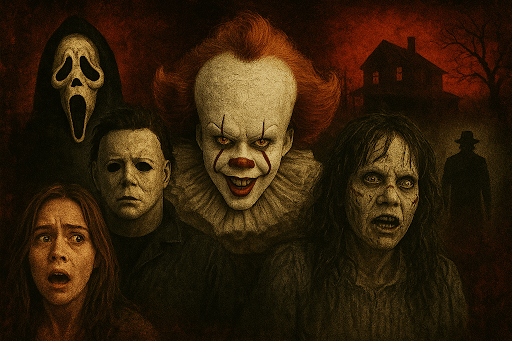
Horror cinema is not merely about sudden “boo!” moments from around the corner. It is the domain of goosebumps, adrenaline, and the creeping sense that something terribly wrong is happening just out of sight.
Let us explore the works that have driven audiences to hysteria and elevated their directors to global fame.
Here we present a list of the top 20 horror films that every devotee of the genre should experience.
We guarantee these remarkable works will both unsettle your nerves and leave a lasting impression.
1. ‘’It’’ (1990) — Dir. Tommy Lee Wallace
Childhood is not only a realm of innocence but also a breeding ground for magnified nightmares. This cult television adaptation of Stephen King’s novel takes us to the small town of Derry, where children face the embodiment of ancient evil — the clown Pennywise. This parasitic entity feeds not on blood but on fear itself, manifesting each child’s deepest anxieties.
Why it endures: rather than relying on cheap scares, this mini-series (effectively a full-length feature) builds its terror upon nostalgia and the trauma of growing up. The performances of the young cast — including a youthful Seth Green — lend it touching sincerity. But the true icon here is Tim Curry’s Pennywise: a performance that blends mischief with inhuman cruelty, proving that the most potent horror comes from the familiar rendered uncanny — evil hiding behind a painted smile. It is fear rooted in the memory of childhood.
2. ‘’Psycho’’ (1960) — Dir. Alfred Hitchcock
A story of escape turns into a nightmare when Marion Crane, having stolen money, seeks refuge in the Bates Motel. Its timid owner, Norman, seems merely an awkward young man dominated by his mother — yet behind this façade lies a chasm of madness.
Why it is foundational: Hitchcock reinvented the language of cinema. The legendary shower scene — a virtuosic dance of editing and Bernard Herrmann’s shrieking strings — generates horror through rhythm and implication rather than explicit violence. Anthony Perkins crafted the archetype of the “mother’s boy” psychopath: dangerous precisely because he appears harmless. ‘’Psycho’’ shattered conventions — killing its heroine mid-film, blurring morality, and revealing that monstrosity can lurk behind the counter of a roadside motel. A cold shower for every complacent viewer.
3. ‘’The Silence of the Lambs’’ (1991) — Dir. Jonathan Demme
Ambitious FBI trainee Clarice Starling receives a chilling assignment: to confront Dr. Hannibal Lecter — brilliant psychiatrist, serial killer, and cannibal — in order to extract insights that might help capture another murderer, “Buffalo Bill.” What follows is a psychological duel of deadly intelligence.
Why it was an Oscar triumph: one of the few horror films to win Best Picture, its secret lies in the alchemy between two extraordinary performances. Anthony Hopkins’s Lecter is the embodiment of refined, intellectual, and utterly ruthless evil, hypnotic in his restraint. Jodie Foster’s Starling provides the perfect counterpoint — fragile yet unbreakable. Demme builds intellectual and emotional tension so acute that the true horror lies not in physical violence but in Lecter’s piercing ability to see into the soul’s weaknesses. A masterclass in psychological suspense, exploring the nature of evil and resilience.
4. ‘’Sinister’’ (2012) — Dir. Scott Derrickson
Writer Ellison Oswalt, desperate for inspiration, makes a fatal mistake by moving his family into a house marked by a brutal murder. In the attic, he discovers a box of home movies depicting ritualistic killings. With that discovery, the ancient deity Bughuul begins his invisible hunt.
Why it stands out: “Sinister’’ is pure atmospheric dread. Derrickson understands that fear thrives in silence, shadow, and anticipation. The chilling “snuff films” — particularly the lawnmower scene — create an aura of genuine evil. Sound design itself becomes an instrument of torture. The terror here lies not in gore but in the sense of inexorable doom: the realization that ancient evil is already among us, and escape is futile.
5. ‘’Oculus’’ (2013) — Dir. Mike Flanagan
Trauma never heals. Siblings Kaylie and Tim return to the home where, years earlier, their father murdered their mother under mysterious influence. Kaylie believes the culprit is an antique mirror — and sets out to prove its malevolent power through experiment, at the risk of her sanity.
Why it is intelligent horror: ‘’Oculus’’ overturns expectations. The mirror is no passive object but an active manipulator, blurring the lines between past and present, truth and hallucination. Flanagan interweaves timelines with dizzying precision, creating a sensation of descent into madness. The horror is multifaceted — fear of losing one’s mind, the scars of loss, the power of objects to warp perception. A cerebral, disorienting exploration of memory and delusion.
6. ‘’The Birds’’ (1963) — Dir. Alfred Hitchcock
Playful socialite Melanie Daniels visits the quiet coastal town of Bodega Bay to surprise lawyer Mitch Brenner. Her arrival coincides with inexplicable, violent bird attacks. The peaceful natural world turns against humankind.
Why it is a masterpiece: Hitchcock proves that horror requires no monsters — only nature unbound. ‘’The Birds’’ is a study in escalating panic: each wingbeat, each eerie silence before the next assault builds unbearable tension. The film examines humanity’s fragile order before the irrational forces of chaos. The absence of motive makes it pure, elemental terror.
7. ‘’The Witch’’ (2015) — Dir. Robert Eggers
New England, 1630s. A Puritan family, exiled from their colony, settles at the edge of a dark forest. After their infant disappears and crops fail, paranoia and religious fanaticism corrode them from within. The daughter Thomasin is accused of witchcraft.
Why it is art-house horror: ‘’The Witch’’ immerses the viewer in historical authenticity and existential dread. It is a slow, suffocating descent into isolation, superstition, and madness. The terror emerges from faith, repression, and the wild unknown. Eggers’s meticulous recreation of language, costume, and belief makes the nightmare disturbingly real. A slow-acting poison, not a jolt of adrenaline.
8. ‘’The Blair Witch Project’’ (1999) — Dirs. Daniel Myrick & Eduardo Sánchez
Three student filmmakers venture into the woods to document a local legend — the Blair Witch. After nights of strange noises and ominous symbols, they vanish. A year later, only their footage is found.
Why it was revolutionary: ‘’The Blair Witch Project’’ popularized the “found footage” format. Its brilliance lies in minimalism and suggestion. The unseen threat, the shaky camera, and the escalating hysteria compel the viewer to imagine the horror — always more terrifying than anything shown. A sense of authenticity and despair that predated the viral age.
9. ‘’Midsommar’’ (2019) — Dir. Ari Aster
Still grieving a personal tragedy, Dani accompanies her boyfriend and friends to a remote Swedish commune for a midsummer festival. Beneath the bright sun, amidst flowers and smiles, lurk ancient, horrifying rituals.
Why it is unique: ‘’Midsommar’’ dismantles the genre’s conventions — horror unfolds not in darkness but under relentless daylight. Aster creates a film of stunning visual beauty and psychological devastation, a meditation on grief, emotional decay, and communal control. Hypnotic, disturbing, and symbolically rich, it is a psychedelic nightmare bathed in white.
10. ‘’Get Out’’ (2017) — Dir. Jordan Peele
Chris, a Black man, visits the family of his white girlfriend, Rose. Their excessive politeness masks an ever-growing sense of menace, leading Chris to uncover a monstrous conspiracy.
Why it became a cultural phenomenon: ‘’Get Out’’ fuses social satire, thriller, and horror with surgical precision. Peele uses genre as critique — exposing racism, cultural appropriation, and microaggressions. The film both terrifies and provokes thought. Its metaphors (the “sunken place”), dialogue, and twists have entered pop culture, redefining horror for the modern era.
11. ‘’Drag Me to Hell’’ (2009) — Dir. Sam Raimi
Loan officer Christine Brown, eager to impress her boss, denies an elderly Romani woman an extension. The woman retaliates with the Lamia curse, condemning Christine to torment and damnation.
Why it’s pure fun: Raimi returns to his roots (The Evil Dead) with an exuberant blend of grotesque humor, cartoonish violence, and surreal chaos. A reminder that horror can be deliriously funny and viscerally tactile — full of slime, insects, and flying debris.
12. ‘’Rosemary’s Baby’’ (1968) — Dir. Roman Polanski
Young couple Rosemary and Guy Woodhouse move into an old New York apartment building. After a disturbing dream and a mysterious pregnancy, Rosemary suspects her husband and neighbors are part of a satanic conspiracy to claim her unborn child.
Why it is the template for paranoia: Polanski masterfully builds tension through isolation and distrust. Mia Farrow’s fragile performance captures the slow erosion of security. The film probes primal fears — loss of bodily autonomy, betrayal, and the invasion of evil into motherhood. Its atmosphere of suffocating “kindness” remains unmatched.
13. ‘’The Shining’’ (1980) — Dir. Stanley Kubrick
Writer Jack Torrance becomes the winter caretaker of the remote Overlook Hotel, bringing along his wife Wendy and son Danny, who possesses psychic “shining.” Isolation, the hotel’s dark past, and supernatural forces drive Jack into madness.
Why it is a visual nightmare: Kubrick crafts a cold, monumental masterpiece — a slow descent into insanity shaped by geometry, symmetry, and dread. The labyrinthine corridors, the oppressive emptiness, and Jack Nicholson’s iconic performance (“Here’s Johnny!”) form a mosaic of terror. Every frame brims with symbols and mysteries — the maze, the blood-filled elevator — capturing horror as existential entropy.
14. ‘’The Mummy’’ (1999) — Dir. Stephen Sommers
In the 1920s, librarian Evelyn and adventurer Rick set out for Hamunaptra, the city of the dead. Their curiosity awakens Imhotep, a cursed priest seeking to resurrect his lost love.
Why it deserves mention: though an adventure-horror hybrid, ‘’The Mummy’’ earns its place for its box-office success, charismatic leads (Brendan Fraser, Rachel Weisz), and its perfect mix of suspense, humor, and romance. Imhotep is a memorable villain, and the special effects were groundbreaking for their time. Pure cinematic joy with a gothic edge.
15. ‘’Carrie’’ (1976) — Dir. Brian De Palma
Tormented by classmates and her fanatical mother, shy teenager Carrie White discovers telekinetic powers. Humiliation at prom unleashes her vengeance in apocalyptic fashion.
Why it is a tragic classic: De Palma’s stylistic bravura — split screens, slow motion — heightens the emotional impact. Sissy Spacek’s performance transforms victimhood into transcendence and tragedy. A meditation on cruelty, repression, and explosive catharsis. The prom blood scene and the graveyard hand remain indelible images of horror history.
16. ‘’The Texas Chain Saw Massacre’’ (1974) — Dir. Tobe Hooper
A group of young travelers in rural Texas encounters a family of cannibals — among them, the chainsaw-wielding Leatherface.
Why it shocked the world: raw, brutal, and seminal. Despite little on-screen gore, its documentary-style realism and frenzied energy evoke true chaos and madness. Leatherface’s grotesque mask became an icon of primal terror. An unrelenting descent into anarchy and fear.
17. ‘’Halloween’’ (1978) — Dir. John Carpenter
On Halloween night, 1963, six-year-old Michael Myers murders his sister. Fifteen years later, he escapes and returns to his hometown to stalk babysitter Laurie Strode.
Why it defined the slasher genre: Carpenter set the template — the silent, unstoppable killer; suburban dread; killer’s POV; minimalist score; and the “final girl” archetype (Jamie Lee Curtis). Michael embodies pure, motiveless evil. A masterclass in suspense and pacing that shaped decades of horror.
18. ‘’Alien’’ (1979) — Dir. Ridley Scott
The crew of the spaceship Nostromo investigates a distress signal. Officer Kane is attacked by a parasitic organism, which later bursts from his body — and the deadly Xenomorph begins its hunt.
Why it is perfection in synthesis: a flawless fusion of science fiction and horror. ‘’Alien’’ is a masterpiece of claustrophobia, design (courtesy of H. R. Giger), and slow-building dread. Ripley (Sigourney Weaver) became an archetype of the strong heroine. “In space no one can hear you scream” — more than a tagline, it is the film’s existential truth.
19. ‘’The Wicker Man’’ (1973) — Dir. Robin Hardy
Devout police sergeant Neil Howie travels to a remote Scottish island to investigate a girl’s disappearance. The local inhabitants practice ancient pagan rituals — and Howie gradually realizes he is part of their horrifying ceremony.
Why it is unique folk horror: combining detective story, musical, and horror, ‘’The Wicker Man’’ creates surreal dissonance between pastoral beauty and impending doom. Its radiant landscapes and cheery songs heighten the final horror — the burning of the wicker effigy — one of cinema’s most shocking and symbolic endings.
20. ‘’The Thing’’ (1982) — Dir. John Carpenter
Antarctica. After a violent encounter with deranged Norwegians, American researchers discover their dog is an alien organism capable of perfectly imitating any living being. Paranoia spreads — who among them is still human?
Why it is the apex of paranoia and isolation: Carpenter’s magnum opus combines groundbreaking practical effects (by Rob Bottin) with suffocating tension. The film’s icy setting mirrors the psychological cold of distrust. ‘’The Thing’’ is not merely a monster movie but a study of identity, fear of the “Other,” and existential hopelessness. Its bleak, ambiguous ending remains peerless.
Warning!!! If you can still sleep peacefully after reading this list, congratulations — either your nerves are made of steel or your fear detector is broken.
The world of cinema overflows with dark tales that quicken the pulse and raise the hairs on your neck. Horror films are not merely about fright — they are vessels of emotion, tension, atmosphere, and revelation.
Ready for a night when even your cat stares suspiciously into the darkness, and your refrigerator begins to hum ominously? Then grab some popcorn and embark on a thrilling journey through the shadowy corners of cinema.
Browse the posters on our site, follow the links, and immerse yourself in the chilling art of horror — feel the atmosphere down to your bones.
-
 Culinary RecipesEveryone’s Favorite Pancakes: an Interesting History and a Classic Recipe
<p dir="ltr"><span style="font-size: 18px;">A pancake lies on your plate—modest, golden, smelling of childhood and butter. Don’t be fooled...
23 Jan 2026, 11:24 -
 ReligionHoliday Prayer (Ṣalāt al-ʿĪd) in Islam: Structure, Symbolism, Significance
<p dir="ltr"><span style="font-size: 18px;">There arrives that singular dawn when the air seems to vibrate with quiet joy. Cities and villages still s...
23 Jan 2026, 08:00 -
 ReligionBeginning the Day with Worship: On the Morning Prayer
<p dir="ltr"><span style="font-size: 18px;">Once, at the very break of dawn, when the world stood still in anticipation of the first ray of light, the...
23 Jan 2026, 06:48