Harry Potter and the Deathly Hallows”: A Finale That Broke Us and Put Us Back Together
The final installment of the Harry Potter saga is anything but a light-hearted fairy tale. It is a story about the price of victory, about sacrifice, and about a generation coming of age together with its heroes. Deathly Hallows concluded t...

Author
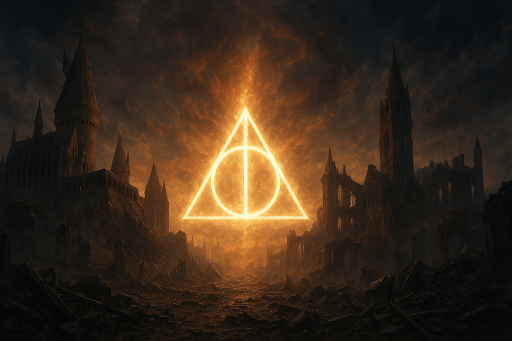
The final installment of the Harry Potter saga is anything but a light-hearted fairy tale.
It is a story about the price of victory, about sacrifice, and about a generation coming of age together with its heroes. Deathly Hallows concluded the cycle in such a way that readers felt both pain and gratitude at once.
Prologue: Flight and Struggle
From the very first pages, everything descends into chaos. The Ministry of Magic has fallen, the Death Eaters control the country, and Harry, Ron, and Hermione are forced into hiding. They have no precise plan—only Dumbledore’s final instruction to find and destroy Voldemort’s Horcruxes.
Their first trial is the “Seven Potters” operation. It is a bold attempt to save Harry, yet it ends in the first tragedies: Mad-Eye Moody is killed, and Hedwig—the symbol of Harry’s childhood—dies.
Insight: Hedwig’s name is associated with a saint regarded as the protector of deceased children. Her death marks the end of Harry’s past.
Insight: The omen of “thirteen at the table” appears several times throughout the series, and it invariably comes true, foreshadowing the fate of several characters.
Snape: The Man We Understood Only Too Late
For most of the series, Snape appears cruel, unjust, and dangerous. But the finale reveals his true nature. His death is not a heroic sacrifice but a brutal execution ordered by Voldemort. Yet the deeper tragedy unfolds in the Pensieve.
We see Snape as a child, his love for Lily, his mistakes, and his unending grief. He was forced to protect the son of the woman he loved while looking into the face of a boy who resembled his own tormentor.
The word “Always” became a symbol of his unwavering devotion.
Insight: Snape’s very first question to the class in Philosopher’s Stone is a coded confession of mourning for Lily, expressed through the symbolism of Victorian flower language.
The Battle of Hogwarts: When Home Becomes a Battlefield
The final battle is not a romanticized vision of war but a chaotic, painful, and brutal clash. Many beloved characters perish:
- Fred Weasley — perhaps the most devastating loss for fans.
- Lupin and Tonks — leaving young Teddy an orphan.
- Colin Creevey — a Muggle-born boy who returned to fight despite his age.
Each death underscores the truth: war breaks lives, and no one is safe.
Insight: The order in which the Marauders die mirrors the order of their names on the Marauder’s Map—but in reverse.
Harry’s Parents and the Philosophy of the Deathly Hallows
The episode in Godric’s Hollow leads Harry to a deeper understanding of the Hallows’ essence. The inscription on his parents’ grave speaks not of triumph over death but of accepting it. This becomes the key to the ending.
Insight: One enduring theory suggests that Dumbledore embodies the figure of Death from The Tale of the Three Brothers:
- Voldemort corresponds to the eldest brother,
- Snape to the middle,
- and Harry to the youngest, who accepts the inevitable.
The decisive moment comes when Harry walks into the Forbidden Forest. He goes to die, accepting his fate without resistance. He is accompanied by the spirits of those closest to him. This is not an assertion of strength, but a gesture of maturity and humility. It is precisely for this reason that he defeats the one who feared death most.
Epilogue: “The scar had not pained him for nineteen years. All was well.”
The epilogue has elicited mixed reactions—from affection to criticism. Yet beneath its apparent simplicity lies a continuation of the theme of growing up.
- The heroes’ children still feel the shadow of the past.
- Draco has matured and carries the weight of his own mistakes.
- Neville becomes a professor—and rightfully so.
The epilogue is not a perfect fairy tale. It is a reminder that life goes on, accompanied by the memory of losses.
Harry Potter and the Deathly Hallows is a novel about a young man who chose not power or solitude, but humanity and responsibility. He triumphed not because he was the strongest, but because he was willing to face fear, pain, and death.
And yes—the line “After all this time? — Always” still brings a lump to the throat for many of us. That is the power of true magic.
And if you’re longing for more enchantment—browse the film listings on our website. You’ll surely find movies where magic shines no less brightly than in Hogwarts. Perhaps a new story awaits you there—one that will make you believe in wonder all over again!
-
 Culinary RecipesEveryone’s Favorite Pancakes: an Interesting History and a Classic Recipe
<p dir="ltr"><span style="font-size: 18px;">A pancake lies on your plate—modest, golden, smelling of childhood and butter. Don’t be fooled...
23 Jan 2026, 11:24 -
 ReligionHoliday Prayer (Ṣalāt al-ʿĪd) in Islam: Structure, Symbolism, Significance
<p dir="ltr"><span style="font-size: 18px;">There arrives that singular dawn when the air seems to vibrate with quiet joy. Cities and villages still s...
23 Jan 2026, 08:00 -
 ReligionBeginning the Day with Worship: On the Morning Prayer
<p dir="ltr"><span style="font-size: 18px;">Once, at the very break of dawn, when the world stood still in anticipation of the first ray of light, the...
23 Jan 2026, 06:48