


Ashwagandha: Ancient Ayurvedic Wisdom in the Light of Modern Science
For more than 3,000 years, the Ayurvedic medical tradition has preserved a special plant—Ashwagandha (Withania somnifera). Also known as Indian ginseng or winter cherry, it has long been valued as a rasayana—a remedy that promot...

Author
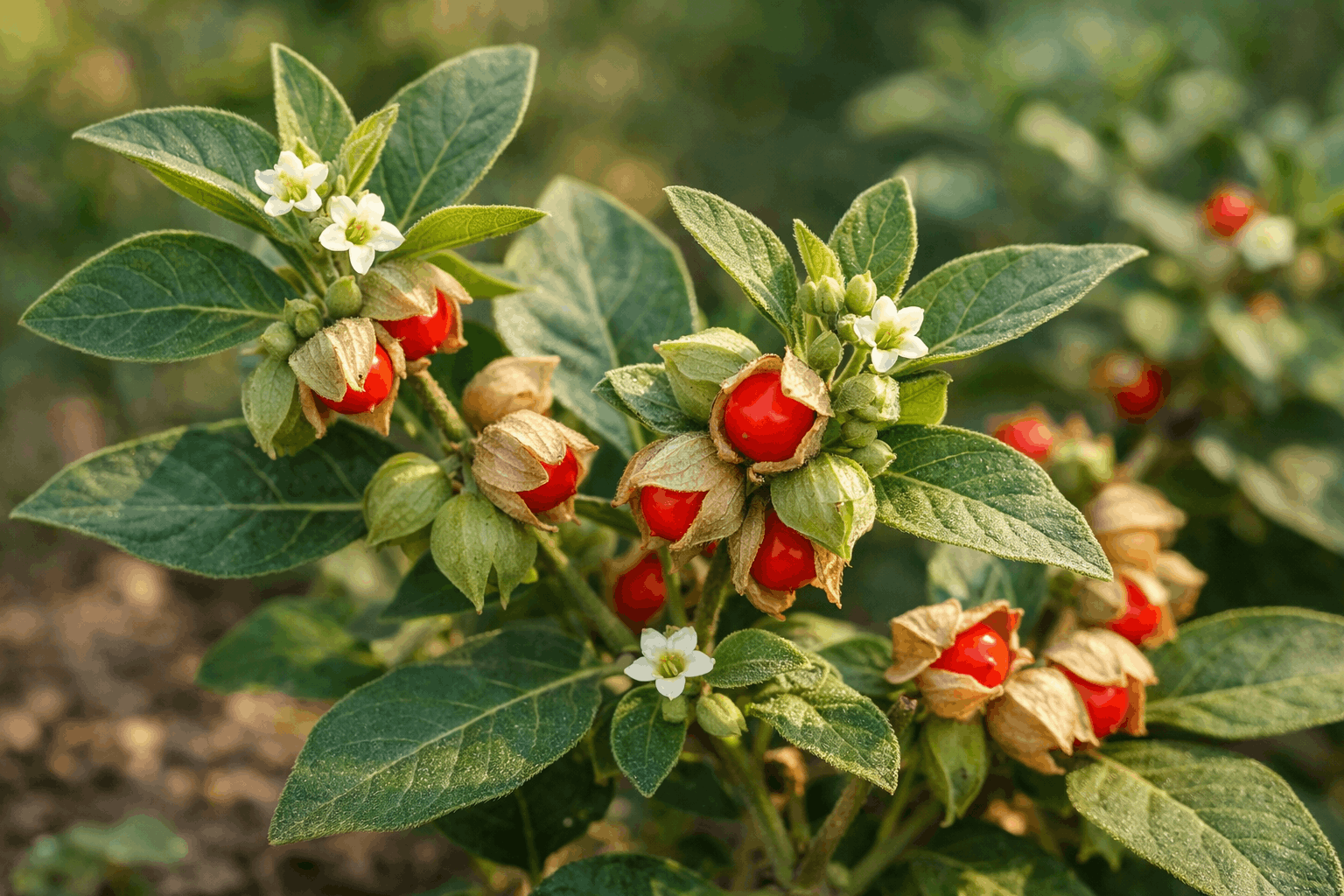
For more than 3,000 years, the Ayurvedic medical tradition has preserved a special plant—Ashwagandha (Withania somnifera). Also known as Indian ginseng or winter cherry, it has long been valued as a rasayana—a remedy that promotes rejuvenation and longevity.
Whereas in the past its authority stemmed from centuries of empirical use, today it is increasingly supported by rigorous clinical research.
This article presents a balanced overview of what contemporary science knows about Ashwagandha: its evidence-based properties, optimal methods of use, and important safety considerations.
1. Fundamental Properties: Adaptogenic Action
A defining characteristic of Ashwagandha is its classification as an adaptogen. Adaptogens are naturally occurring substances that enhance the body’s resistance to a broad range of adverse factors—physical, chemical, and biological—while normalizing physiological functions regardless of the direction of pathological shifts.
Mechanism of action. Adaptogens are neither direct stimulants nor sedatives. Instead, they help the organism adapt to stress by modulating the activity of the hypothalamic–pituitary–adrenal (HPA) axis, the principal neuroendocrine system governing the stress response.
Effects on cortisol. The most extensively studied aspect of Ashwagandha concerns its ability to significantly reduce cortisol—the so-called “stress hormone.” For example, in one 60-day double-blind placebo-controlled trial, supplementation with a standardized extract resulted in a 27.9% reduction in serum cortisol levels among individuals suffering from chronic stress.
Important distinctions among extracts.
- KSM-66 ® is a root-only extract standardized to ≥5% withanolides.
- Sensoril ® is derived from both roots and leaves, also standardized for withanolides.
Contrary to popular misconceptions, high-quality standardized extracts that have undergone clinical testing are considered safe, as the standardization process regulates alkaloid concentration.
2. Key Evidence-Based Health Benefits
2.1. Reduction of Stress and Anxiety
Multiple studies validate the anxiolytic effects of Ashwagandha. A 2022 meta-analysis of five clinical trials demonstrated that supplementation significantly reduced anxiety and stress compared with placebo. This effect is attributed not only to decreased cortisol, but also to modulation of neurotransmitter systems, particularly GABAergic signaling.
2.2. Improvement of Sleep Quality
Ashwagandha’s influence on sleep is largely indirect. By mitigating one of the major drivers of insomnia—stress-related hyperarousal—it facilitates quicker sleep onset, longer duration, and improved subjective sleep quality. In a study involving individuals with insomnia, supplementation with 300 mg of KSM-66® twice daily for 10 weeks led to significant improvement across all measured parameters.
2.3. Support of Cognitive Function
Ashwagandha exhibits nootropic properties. Its antioxidant constituents (e.g., withaferin A) help protect neurons from oxidative damage. Research demonstrates improvements in reaction time, working memory, and executive functioning in both healthy adults and individuals experiencing age-related cognitive decline.
2.4. Enhancement of Physical Performance
In sports and fitness contexts, Ashwagandha has been studied as an ergogenic aid:
- Strength and muscle mass: In resistance-trained men, 300 mg of KSM-66® twice daily for 8 weeks produced significantly greater increases in bench-press and leg-extension strength, as well as muscle mass, compared with placebo.
- Endurance: Improvements in maximal oxygen consumption (VO₂ max) indicate enhanced aerobic capacity.
- Recovery: Anti-inflammatory and antioxidant effects may reduce markers of muscle damage following intense exercise.
2.5. Influence on the Endocrine System
- Thyroid function: evidence suggests that Ashwagandha may support thyroid hormone levels (T3 and T4) in individuals with subclinical hypothyroidism. It is contraindicated in hyperthyroidism and Graves’ disease.
- Male reproductive health: several studies indicate increases in testosterone in men with low baseline levels, alongside improvements in semen parameters (motility, concentration, and volume).
3. Practical Recommendations for Use
- Preferred forms: capsules or tablets containing standardized extract ensure accurate dosing of active constituents.
- Dosage: a typical daily dose ranges from 300–600 mg of standardized root extract, depending on the concentration and desired outcome.
Examples of targeted use:
- Stress reduction: 300–600 mg daily in 1–2 divided doses.
- Sleep improvement: 300–500 mg taken 30–60 minutes before bedtime.
Course duration: Usually 1–3 months, followed by a break. Continuous use should be discussed with a healthcare professional.
Timing:
- Morning/daytime for stress and energy support
- Evening for sleep enhancement
4. Safety Considerations and Contraindications
Despite a favorable safety profile, Ashwagandha is not suitable for everyone. Medical consultation before use is strongly recommended.
Absolute contraindications:
- Pregnancy and lactation
- Autoimmune disorders (e.g., rheumatoid arthritis, multiple sclerosis, systemic lupus erythematosus), due to potential immune-stimulating effects
- Hyperthyroidism and Graves’ disease
Relative contraindications requiring medical supervision:
- Use of sedatives, anxiolytics, antidepressants, antihypertensive or hypoglycemic drugs (potential synergistic effects)
- Active peptic ulcer disease
- Planned surgical procedures (discontinue 2 weeks prior)
Possible side effects (typically mild and transient): drowsiness, gastrointestinal discomfort, headache. Very rarely, hepatotoxic effects have been reported with low-quality extracts.
Conclusion
Ashwagandha offers a compelling example of a traditional botanical remedy successfully entering the domain of evidence-based medicine. Its effectiveness as an adaptogen—reducing stress, improving sleep quality, and supporting cognitive and physical functions—continues to gain empirical support.
Nevertheless, its use requires prudence: one should select high-quality standardized extracts, adhere to recommended dosages, and account for contraindications. Under such conditions, Ashwagandha may serve as a valuable component in strategies aimed at maintaining health and resilience in the modern world.