Minor Ritual Act: Wuḍūʾ (Ṭahārah) in Islamic Practice

Author
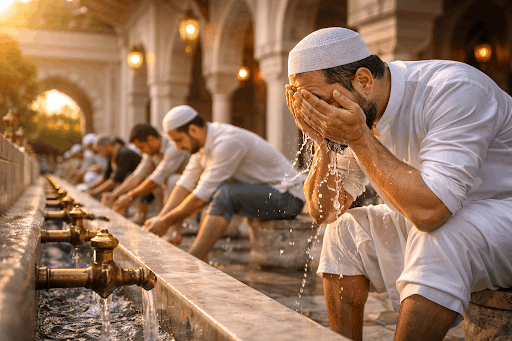
Minor ablution (wuḍūʾ, ṭahārah) is a Shariah-prescribed act of ritual purification that constitutes a necessary condition for the validity of the prayer (ṣalāh), circumambulation of the Kaʿbah (ṭawāf), and serves as a recommended prelude to many other forms of worship. Its importance is underscored in both the Qurʾān and the Sunnah.
The Exalted Allah says: “O you who believe! When you rise to perform the prayer, wash your faces and your hands up to the elbows, wipe your heads, and wash your feet up to the ankles” (Qurʾān 5:6). The Prophet Muḥammad (peace and blessings be upon him) described ablution as the key to prayer.
Obligatory Acts (Farḍ) of Minor Ablution
According to the Ḥanafī and Shāfiʿī schools of law, the essential components of wuḍūʾ—without which it is invalid—are the following:
- Intention (niyyah). It is formed in the heart with the purpose of performing ablution for prayer or another act of worship. Verbal articulation is not required, though it is recommended.
- Wash the face once. The boundaries of the face are: vertically, from the hairline on the forehead to the bottom of the chin; horizontally, from one earlobe to the other. If the beard is thick, its outer surface is washed; if sparse, the skin beneath must be washed.
- Wash the arms up to and including the elbows once.
- Wipe part of the head (masḥ) once. The minimum is wiping a quarter of the head (according to the Ḥanafīs), while a light pass of a wet hand suffices (according to the Shāfiʿīs).
- Wash the feet up to and including the ankles once.
- Observe the prescribed sequence.
The Complete (Recommended) Manner of Wuḍūʾ in Accordance with the Sunnah
The recommended procedure, which entails greater spiritual reward, includes the following steps:
- Pronounce “Bismillāh al-Raḥmān al-Raḥīm” at the beginning of the ablution.
- Wash the hands up to the wrists three times, beginning with the right; rings should be removed or shifted.
- Rinse the mouth (maḍmaḍah) three times, taking water with the right hand; the use of the siwāk is recommended.
- Rinse the nose (istinshāq) three times by drawing water in with the right hand and clearing it with the left.
- Wash the face three times within the specified boundaries.
- Wash the arms up to the elbows three times, beginning with the right, ensuring water reaches between the fingers.
- Wipe the entire head (masḥ) once: with wet palms, pass from the forehead to the nape and back. Without taking new water, wipe the ears—using the index fingers inside and the thumbs outside. Wiping the neck is considered recommended by some scholars.
- Wash the feet up to the ankles three times, beginning with the right foot, carefully washing between the toes.
- After completing wuḍūʾ, recite the testimony of faith (shahādah) and the prescribed supplication (duʿāʾ):
“Ashhadu an lā ilāha illā Allāhu waḥdahu lā sharīka lahu, wa ashhadu anna Muḥammadan ʿabduhu wa rasūluhu. Allāhumma-jʿalnī mina al-tawwābīn wa-jʿalnī mina al-mutaṭahhirīn.”
(I bear witness that there is no deity except Allah alone, without a partner, and I bear witness that Muḥammad is His servant and Messenger. O Allah, make me among those who repent and among those who purify themselves.)
Conditions and Requirements Concerning Water
Any pure water is suitable for ablution: tap water, spring water, well water, as well as seawater, as established by prophetic reports. The water must be purifying (ṭāhir) and free from perceptible changes in color, taste, or smell. If substances that prevent water from reaching the skin or nails are present (such as greasy creams, paint, nail polish, or sealants), the ablution is invalid until they are removed. This is particularly relevant for women with respect to nail polish.

Acts That Invalidate Minor Ablution (Nawāqiḍ al-Wuḍūʾ)
The state of ritual purity is nullified, necessitating renewal of ablution, in the following cases:
- Any discharge from the front or rear passages (urine, feces, gas, etc.).
- Blood or pus flowing beyond the wound.
- Vomiting that fills the mouth.
- Sleep while lying down or reclining in a manner that entails loss of awareness (light drowsiness while seated, without loss of control, does not invalidate ablution).
- Loss of consciousness, fainting, or severe intoxication.
- Loud laughter during the prayer (according to the Ḥanafī school).
- Direct contact of the private parts without a barrier (according to the majority of schools).
- Consumption of camel meat (based on several prophetic reports and the opinion of some scholars).
Ablution for Women and Special Circumstances
The procedure of wuḍūʾ for women does not differ from that for men. In the case of full ritual bathing (ghusl), a woman must ensure that water reaches the roots of all her hair; however, it is not obligatory to undo tightly braided hair, provided that water reaches the scalp.
In special circumstances—such as illness, injury, or lack of water—concessions apply:
- When water cannot be used due to illness or its absence, tayammum (dry purification with clean earth) is performed.
- If a bandage covers a wound that cannot be removed, the unaffected parts are washed, and a wet wiping (masḥ) is performed over the bandage.
By performing minor ablution in accordance with these rules, the believer not only fulfills a prerequisite of worship but also attains spiritual purification.
As stated in a prophetic report: “When a servant (of Allah) performs ablution and rinses his mouth, the sins of his mouth depart. When he rinses his nose, the sins of his nose depart. When he washes his face, the sins of his face depart… until he emerges purified from sins.”
-
 Family LifeThe True Superhero of Nature: The Axolotl’s Regeneration
He never truly grows up. He reproduces while still a larva. He regenerates lost organs. And he always seems to smile. Meet the axolotl—an organism that has outwitted the rules of biology and bec...
17 Jan 2026, 13:16 -
 Family LifeTahajjud Prayer: A Hidden Devotion in the Stillness of the Night
Among the many spiritual practices in Islam, the night prayer—Tahajjud—occupies a distinctive place. This voluntary form of worship, performed after the obligatory ‘Isha prayer and b...
17 Jan 2026, 12:49 -
 Family LifeMaltipoo — a Dog Designed for Happiness
Forget everything you know about dogs — none of it applies here. No service merits, no hunting talents, no noble tomes of pedigree records. That’s a whole different universe. The Maltipoo...
17 Jan 2026, 12:16