



Panic Attack: A Guide to Disarming Your Inner Saboteur
A panic attack is an uninvited guest who barges into your home without knocking. You are not to blame for its arrival. But you can show it the door. You are not weak—your nervous system is simply highly sensitive. And sensitivity is a...

Author
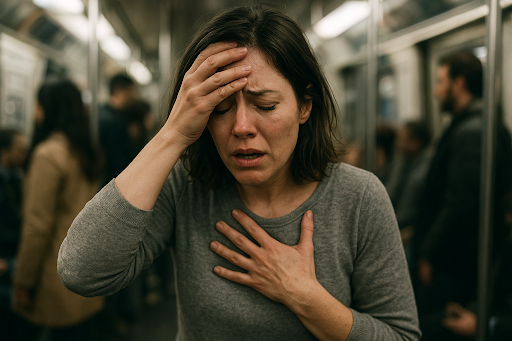
A panic attack is an uninvited guest who barges into your home without knocking. You are not to blame for its arrival. But you can show it the door. You are not weak—your nervous system is simply highly sensitive. And sensitivity is a gift, though one that requires skill to manage. Start with a single step—perhaps with breathing. Then, seek a physician. You will cope. This is merely another storm, and you are the captain learning to navigate your vessel in any weather.
Spoiler: rest assured, you are not dying, you are not losing your mind, and we are about to teach you how to turn your nose up at this pesky intruder.
It usually begins innocently enough: you are riding the subway, sipping coffee, or watching a show. And suddenly… the ground disappears beneath your feet. Your heart hammers like a deranged woodpecker trapped in a metal barrel. Your throat tightens. Cold sweat, trembling, a sense of unreality. And above all—an icy, primal, utterly irrational fear. The fear of dying. Right now.
Sound familiar? If so, you’ve just encountered a panic attack—the most widespread and senseless malfunction of our era. Thirty years ago, you might have been told to “pull yourself together” or “stop imagining things.” Today we know better: this is no illusion but a genuine biochemical storm within you. And now we’ll take it apart piece by piece.
What Was That, Exactly? Introducing Your Inner Alarm System
A panic attack is akin to a fire alarm that goes off because a match was lit in a distant galaxy.
Physiologically, this is an ancient fight-or-flight mechanism. Your brain lights up a warning sign—“TIGER!”—even if the most threatening thing around you is an irritating coworker or a crowded train car. The adrenal glands, without checking the facts, release a massive dose of adrenaline into your bloodstream. And the chain reaction begins: your heart races to help you run faster; your breathing quickens; blood flows away from the skin and cortex (hence the dizziness and numbness). All of this is meant to save you from a threat that does not actually exist.
Insider note: this malfunction is often labeled “VSD” (vegetative-vascular dystonia) in some countries. Foreign clinicians cringe at this term. It is the equivalent of diagnosing someone with “syndrome of feeling unwell.” It says nothing.
Typical demographic profile: most often young women aged 20–30, perfectionistic, residents of large cities. A body exhausted by chronic stress and relentless pace simply stages a rebellion—dramatic and immersive.
Symptoms, or: “Doctor, I’m Dying—Check Everything!”
Let’s be honest: during an attack, it feels like either a heart attack, a stroke, or the onset of madness. But there are key distinctions.
The classic symptom set includes:
- Rapid heartbeat (as though the heart is trying to escape through your throat)
- Shortness of breath, a sense of suffocation (as if breathing through cloth)
- Dizziness, weakness (your legs turn to rubber)
- Trembling (shaking like an aspen leaf)
- Sweating, chills (alternating heat and cold)
- Nausea, stomach discomfort (like pre-exam nerves multiplied by a hundred)
- Derealization (the world feels foggy, like watching a bad movie)
- And the main feature: fear of death, loss of control, or going insane
The important information: actually, a panic attack itself is not dangerous. No one has ever died from a panic attack. The real problem is the fear of its recurrence. That fear traps you. You begin avoiding public spaces, transportation, and crowds. That is agoraphobia—the closest companion of chronic panic.

What to Do When It Hits: An Emergency Protocol
When your world collapses, you don’t need a physiology lecture. You need action.
1. Breathe—correctly.
Forget the outdated advice to breathe into a paper bag; it may worsen the situation. Use “box breathing”:
- Inhale for a count of 4
- Hold for 4
- Exhale for 4
- Hold for 4
Focus on the counting. Exhale longer than you inhale—this physiologically calms the nervous system.
2. Engage your inner detective.
If your brain is panicking, give it a simple task. Try the 5–4–3–2–1 grounding technique:
- Identify 5 things you can see
- 4 things you can touch
- 3 things you can hear
- 2 things you can smell
- 1 thing you can taste
This anchors you back in reality.
3. Become deliberately boring.
Focus on something tedious. Count the buttons on someone’s jacket. Recall all the songs from your adolescence. Run through multiplication tables in your head. Your goal is to distract the mind from catastrophizing.
4. Do not run.
The instinct is to flee. Resist it. Stay where you are, preferably sit down. Call a friend. Speak to someone—even a stranger. A simple “Excuse me, I’m feeling unwell” is already a step toward regaining control.
How to Prevent Recurrence: Long-Term Strategy
A single attack is an accident; repeated episodes form a pattern. Let’s break it.
1. See a physician—seriously.
Start with a general practitioner, neurologist, or cardiologist. Rule out medical conditions (thyroid disorders, cardiac issues, anemia). If your physical health is intact, proceed to a psychotherapist or psychiatrist. There is no shame—only wisdom.
2. Psychotherapy is not merely “talking about childhood.”
The most effective approach is cognitive-behavioral therapy (CBT). It will teach you to:
- Recognize distorted thoughts (“my heart is racing—I must be dying!”)
- Replace them with realistic ones (“this is a stress response; it will pass within 10 minutes”)
- Manage your physiological and cognitive reactions
3. Medication is not the enemy.
Antidepressants and anxiolytics serve as temporary support—crutches that help you reach therapy and address root causes. They must be prescribed by a doctor. No self-medication.
4. Reset your lifestyle.
- Caffeine and alcohol: limit or avoid—they provoke the “inner beast.”
- Physical activity: light cardio boosts endorphins—natural antagonists of anxiety.
- Sleep: your primary armor. Sleep deprivation renders the nervous system vulnerable.
-
 Culinary RecipesEveryone’s Favorite Pancakes: an Interesting History and a Classic Recipe
A pancake lies on your plate—modest, golden, smelling of childhood and butter. Don’t be fooled. It’s one of the oldest gastronomic t...
23 Jan 2026, 11:24 -
 ReligionHoliday Prayer (Ṣalāt al-ʿĪd) in Islam: Structure, Symbolism, Significance
There arrives that singular dawn when the air seems to vibrate with quiet joy. Cities and villages still slumber, yet in Muslim homes lights begin to...
23 Jan 2026, 08:00 -
 ReligionBeginning the Day with Worship: On the Morning Prayer
Once, at the very break of dawn, when the world stood still in anticipation of the first ray of light, the Prophet Muḥammad (peace and blessings be up...
23 Jan 2026, 06:48