Vinaigrette: A Boring Cafeteria Salad or a Culinary Chameleon?

Author
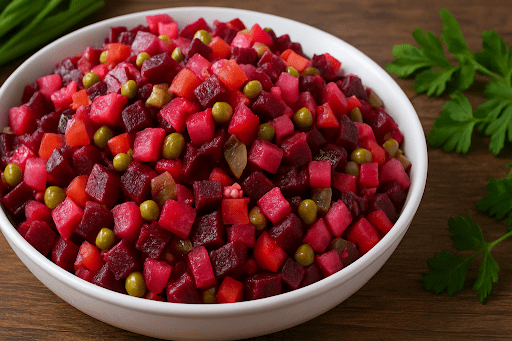
They call it “the poor man’s salad,” yet it has outlived all those Caesars and Oliviers. While those flaunted truffles and lobsters, the vinaigrette humbly waited its turn in the refrigerator—marinating, maturing, and only getting better with time. The irony is that today, in an age of local produce and mindful consumption, it has become one of the most fashionable dishes on the planet.
The secret of a great vinaigrette lies not in the recipe but in the technique. One small trick with oil separates the amateur from the master. Ready to learn how to keep the beets from turning everything into a uniform pink mush—and instead let them hold onto their “bloody revolution”? Then read on!
Spoiler: this article will change your attitude toward Soviet culinary heritage. After reading it, you’ll never make vinaigrette the same way again.
The Classic Everyone Forgot
There are no strict proportions. Everything depends on your taste and the degree of chaos in your soul. This is not engineering—it’s abstract art. But to give you a starting point, here’s a rough balance of power on the kitchen front:
- 2 medium beets — the star of the show and the most temperamental performer.
- 4–5 medium potatoes — the neutral side, the structural foundation.
- 2 medium carrots — for sweetness and color contrast.
- 5–6 medium pickled or salted cucumbers — that satisfying crunchy punch below the belt.
- 1 onion (white or red) — for tears and sharpness; indispensable.
- 250 g canned green peas — the frivolous note that reconciles everyone.
- 5–6 tablespoons of vegetable oil — the bottomless lake where everything drowns.
- ¼–½ teaspoon of salt — a mere formality.
Chef’s tip: many can’t imagine vinaigrette without sauerkraut. It’s the rightful partisan of this ensemble—can be used instead of cucumbers or alongside them, strengthening the “acidic strike force.”
So How Do You Actually Make It?
Here begins the real drama—a process that splits families into two camps: “Boil” versus “Roast.”
- The Vegetable Battle.
Scrub but don’t peel your beets, potatoes, and carrots. Place them in pots and cover with cold water.
Crucially: boil the beets separately—otherwise they’ll unleash a red terror and dye everyone pink. Potatoes surrender after 20–30 minutes, carrots hold out for 30–40, and beets, stubborn as always, take at least an hour. - The Art of Cutting.
Cool, peel, and dice everything into medium cubes. Finely chop the onion. This is a meditative process. Add peas, oil, and salt. Mix. If you don’t fear the “khaki” shade, toss everything together at once. - The Main Hack (the whole point of this exercise).
Do you want aesthetic perfection? So that the beets don’t stain the rest? First mix them with a small amount of oil—this forms a protective barrier. Then introduce the potatoes, carrots, and the rest of the rebels.
Micro-story: “We also add sauerkraut, and sometimes replace peas with beans…” And so it begins. Someone innocently shares a family secret, and instantly loses three karma points. Culinary wars are the fiercest.
4. The Final Act — Infusion.
Let the vinaigrette rest in the refrigerator for several hours or overnight. During this truce, the warring factions reconcile, flavors meld, and that very harmony of childhood is born.
Variations on Controlled Chaos
Classics are boring. True heroes go further and add:
- Instead of peas — canned or boiled beans. A more serious, protein-forward move.
- Pickled mushrooms (200–250 g) — to deepen the forest vibe.
- Fresh greens — dill, parsley, or scallions, to remind you that it’s not eternal winter outside.
- A “Smokehouse” dressing: oil + salt + ½–1 tbsp vinegar + a pinch of black pepper. For those who think life lacks acidity.
- And if you’re ready to go completely mad—there are versions with herring, squid, apple, olives, even seaweed. That’s no longer a salad; that’s a full-blown culinary performance by a real cook.
Vinaigrette isn’t about a recipe—it’s a state of mind. It’s about creating something brilliant out of three root vegetables, a can of peas, and some pickles. It’s the most democratic of dishes, tolerant of any experiment.
It annoyed our fathers because it seemed endless—you could eat it all week and it still wasn’t gone. It was the Monday regular, made in bulk over the weekend.
It’s the ultimate protest against culinary snobbery—cheap, simple, and ingenious. Make it today. And let it rest. Because like all good things in life, it takes time to become truly great.
And if you need supplies—check out the grocery stores on our yellow pages and pick up everything you need to make your perfect vinaigrette.
-
 Family LifeThe True Superhero of Nature: The Axolotl’s Regeneration
He never truly grows up. He reproduces while still a larva. He regenerates lost organs. And he always seems to smile. Meet the axolotl—an organism that has outwitted the rules of biology and bec...
17 Jan 2026, 13:16 -
 Family LifeTahajjud Prayer: A Hidden Devotion in the Stillness of the Night
Among the many spiritual practices in Islam, the night prayer—Tahajjud—occupies a distinctive place. This voluntary form of worship, performed after the obligatory ‘Isha prayer and b...
17 Jan 2026, 12:49 -
 Family LifeMaltipoo — a Dog Designed for Happiness
Forget everything you know about dogs — none of it applies here. No service merits, no hunting talents, no noble tomes of pedigree records. That’s a whole different universe. The Maltipoo...
17 Jan 2026, 12:16