



Driver’s Licenses in Azerbaijan: How to Pass the Exam When the Decision Is No Longer Made by an Inspector, but by a Robot
We are willing to wager that your first association with the phrase “driver’s license” is not a neat plastic card, but trembling knees, a stern inspector in the passenger seat, and a back soaked through with sweat. You are...

Author
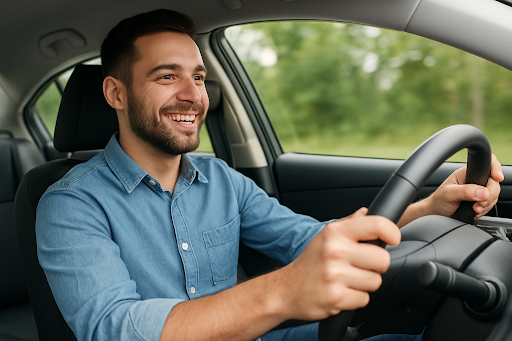
We are willing to wager that your first association with the phrase “driver’s license” is not a neat plastic card, but trembling knees, a stern inspector in the passenger seat, and a back soaked through with sweat. You are not alone. Obtaining a driver’s license in Azerbaijan has long resembled a quest titled “Survival in Baku Traffic: Beginner Edition.”
However, ladies and gentlemen, we live in the future. That very inspector whose heavy gaze used to evaporate all confidence is now… receding into the shadows. His place is being taken by a soulless yet impartial detector. A digital Big Brother for aspiring drivers has already arrived. Would you like to know how this path now looks—and how to navigate it without losing your sanity? Make yourselves comfortable (though not behind the wheel just yet), and let us explain.
Spoiler alert: things are no longer the way your friends described them.
The Main Narrative
Remember the stories about “waving to a friendly inspector who would kindly overlook a crooked parallel parking attempt”? Forget them. The era of the “human factor” in Azerbaijan’s practical driving exam is quietly but steadily coming to an end—particularly in pilot mode in Sumgayit. Your principal examiner is no longer a stone-faced police officer, but a system of sensors, GPS, and sophisticated monitoring equipment.
What actually happens? You sit in the car. Around you is not merely a training ground, but a high-tech trap. Your speed, trajectory, and precision in executing maneuvers are recorded by special detectors. On a monitor, you can observe in real time how your mistakes are converted into penalty points. The inspector? He is somewhere nearby, observing, but his subjective opinion is no longer decisive. Judgment is rendered by machinery. One could almost call it a benevolent dystopia—technology in the service of fairness.
Yet technology is only the beginning. Let us proceed methodically and outline the road to that coveted plastic card.
Step 0: Do You Even Need This? (Age and Health)
You must be at least 18 years old. There is no upper age limit—you may apply at 90, provided your health permits. However, there is a caveat: after the age of 70, licenses are issued for only two years at a time, after which medical checks must be repeated. Thus, the dream of obtaining a license “for life” at 18 is illusory. Licenses must be renewed periodically: at 60, they are issued for 10 years; at 70, for just two.
Step 1: Paperwork and a Matter of Destiny (Manual vs. Automatic)
A medical certificate is mandatory—without it, nothing proceeds. Here is an important detail, introduced in 2017 and still unknown to many: for category “B,” you may take the exam in either a manual or an automatic transmission vehicle. Pass with a manual, and you may drive both. Pass with an automatic, and your fate is sealed—you are restricted to automatics. This is a decision that will determine whether you later curse the world while starting uphill, or serenely enjoy life.
Step 2: Education or Adventure?
In theory, for categories A, A1, and B, self-study is permitted. In practice, almost everyone enrolls in a driving school. Prices typically range from 50 to 80 AZN. Be prepared, however, for your interaction with the school to consist of two meetings: one to pay, and one to collect your certificate. The actual learning is often self-directed. Study the test questions. Use the internet.
Step 3: Theory. Ten Questions. Nine Lives.
You will report to the Main Traffic Police Department in Khirdalan. You are given 15 minutes to answer 10 questions, with only one mistake allowed. It resembles Russian roulette, but with road signs. Pass, and you proceed. Fail, and prepare to pay 10 manats for each additional attempt. Be warned: questions may be phrased to catch inattentiveness. Read carefully.
Step 4: Practice. An Encounter with the Robot.
Here lies the new reality. You are not simply driving around a course; you are a test subject in a digital laboratory. Sensors record everything. A harsh start? A penalty point. Failure to signal? Another point. Crossing a virtual line? The monitor immediately reports your transgression. Ironically, this may be the most honest stage of the entire process. There is no room for “I didn’t notice.” The system notices everything.
Mopeds Become Full-Fledged Vehicles

Here comes a long-awaited—or perhaps unwelcome—surprise for those who regarded mopeds as symbols of carefree freedom from rules, taxes, and bureaucracy. The authorities have decided that these “iron steeds” must also enter the legal framework. Soon—possibly as early as 2026—a category A1 license will be required to operate a moped.
What qualifies as a moped under the new rules? A two- or three-wheeled vehicle with an engine of up to 50 cubic centimeters, or an electric motor, with a maximum speed of 50 km/h. If you once zipped through courtyards without regard for traffic regulations, you will now need not only to pass an exam, but also to register your “steel companion” with state authorities.
And forget the tradition of transporting impossibly oversized cargo: any load extending more than half a meter beyond the vehicle’s dimensions, or interfering with control, is now prohibited. Experts call this a vital step toward safety, noting that “moped riders often neglect both their own safety and that of others.” Civilization has reached yet another enclave of anarchy. The era of consequence-free moped escapades is drawing to a close.
How Much Does “Happiness” Cost?
Official expenses include the examination fee (20 AZN), the license itself (18 AZN), and driving school tuition. Altogether, this amounts to several hundred manats. Persistent rumors—dismissed by traffic police as mere rumors—suggest the existence of an “alternative” market, with prices ranging from 1,000 to 1,500 AZN. The police respond curtly: “If you have complaints, submit a formal statement and we will investigate.” The paradox is that with the introduction of technology, this gray market should, in theory, disappear. Yet, as we know, demand inevitably generates supply.
The Road to the Future
Obtaining a driver’s license in Azerbaijan no longer resembles an initiation rite presided over by an unpredictable inspector-priest. It is increasingly a standardized, technological process. Is it intimidating? In a different way. But it is also fairer. Your task now is not to please a human being, but to understand the logic of a machine—and to master traffic regulations.
Technology reduces corruption and subjective judgment, but it does not absolve you of the responsibility to be a competent driver. An algorithm may evaluate you, but it is you who will ultimately take to the road. And remember: even with a license in your pocket, you are only at the beginning of the journey.
Good luck—and keep your eyes open. Even if a camera is watching.
-
 Culinary RecipesEveryone’s Favorite Pancakes: an Interesting History and a Classic Recipe
A pancake lies on your plate—modest, golden, smelling of childhood and butter. Don’t be fooled. It’s one of the oldest gastronomic t...
23 Jan 2026, 11:24 -
 ReligionHoliday Prayer (Ṣalāt al-ʿĪd) in Islam: Structure, Symbolism, Significance
There arrives that singular dawn when the air seems to vibrate with quiet joy. Cities and villages still slumber, yet in Muslim homes lights begin to...
23 Jan 2026, 08:00 -
 ReligionBeginning the Day with Worship: On the Morning Prayer
Once, at the very break of dawn, when the world stood still in anticipation of the first ray of light, the Prophet Muḥammad (peace and blessings be up...
23 Jan 2026, 06:48