



Holiday Prayer (Ṣalāt al-ʿĪd) in Islam: Structure, Symbolism, Significance
There arrives that singular dawn when the air seems to vibrate with quiet joy. Cities and villages still slumber, yet in Muslim homes lights begin to glow. Today is ʿĪd — a festival day. After the long days of fasting in Ramaḍān or on...

Author
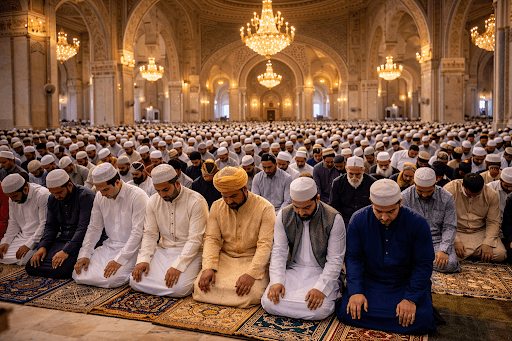
There arrives that singular dawn when the air seems to vibrate with quiet joy. Cities and villages still slumber, yet in Muslim homes lights begin to glow. Today is ʿĪd — a festival day. After the long days of fasting in Ramaḍān or on the eve of ritual sacrifice, the hearts of believers are filled with a distinct, solemn excitement. At the center of this day stands Ṣalāt al-ʿĪd — the festive congregational prayer that gathers the entire community, young and old alike.
This is not merely a ritual act; it is a return to origins, to those very days when the Prophet Muḥammad (peace and blessings be upon him), in Medina, declared that God had granted the believers two great festivals in place of earlier celebrations. For more than fourteen centuries, on the first day of Shawwāl and on the Day of Sacrifice in Dhū al-Ḥijja, Muslims across the world have performed this distinctive act of worship.
Preparation: From Purity of Heart to Purity of Garment
The festival does not begin with the prayer itself, but with intention. Even before sunrise, a benevolent bustle fills the household. A full ritual bath (ghusl) is performed. One dons the finest and most dignified clothing. Men apply perfumed oils, underscoring the festive solemnity of the moment. In these gestures there is no vanity, but rather an expression of joy and gratitude toward the Creator.
A subtle distinction separates the two ʿĪd celebrations. On ʿĪd al-Fiṭr it is sunna to take light nourishment before the prayer — even a date or something sweet — symbolizing the completion of the fast. On ʿĪd al-Aḍḥā, by contrast, it is preferable to postpone eating until after the sacrifice, so that the first meal of the day may be from the sacrificial animal.
The Path to Prayer: Takbīrs, Communal Presence, and Humility
The walk to the site of the ʿĪd prayer constitutes, in itself, a component of worship. The sunna is to proceed on foot, unhurried and dignified. Men, women, and children all head toward a common gathering place. Historically, following the example of the Prophet, the prayer is preferably performed outdoors, in an open area, under the sky — symbolizing the expansiveness of God’s mercy. If weather conditions are adverse or no suitable space is available, assembly in the mosque is permitted.
Along the way, takbīrs — formulae glorifying God — are recited. They are not chanted collectively in unison but spoken individually, from the heart, filling the streets with a gentle, reverent murmur:
“Allāhu akbar, Allāhu akbar, lā ilāha illā Allāh, Allāhu akbar, Allāhu akbar, wa li-Llahi l-ḥamd.”
Women proceed modestly, avoiding ostentatious attire and perfume, yet they remain an integral part of the communal body. Even those who, for legitimate reasons, do not perform the prayer itself come to partake in the joy, to listen to the sermon, and to engage in remembrance (dhikr).
It is notable that the imam, as in the case of the Friday prayer, arrives later than the rest, at the very beginning of the ritual. Another beautiful sunna is to take one route to the prayer and return by another, thereby symbolically extending the blessing of the festival across different paths.
The Heart of the Festival: Two Rakʿahs of a Distinctive Prayer
When the community has gathered, neither adhān nor iqāma is pronounced. The summons consist simply of the words: al-ṣalātu jāmiʿa (“The prayer is assembling”). The worshippers align themselves in orderly rows.
The ʿĪd prayer consists of two rakʿahs, yet it possesses a remarkable distinguishing feature — additional takbīrs. In the first rakʿah, after the opening takbīr and the recitation of the thanaʾ, the imam, followed by the congregation, raises the hands and proclaims “Allāhu akbar.” The number of these additional takbīrs varies across legal schools (most commonly seven in the first rakʿah and five in the second), yet their purpose is unified: they mark peaks of glorification of the Creator on a day suffused with His mercy.
Between the takbīrs one may quietly praise God. Thereafter the imam recites Sūrat al-Fātiḥa and an additional sūra (often Sūrat al-Aʿlā in the first rakʿah).
In the second rakʿah, after the Qurʾānic recitation and before bowing (rukūʿ), the additional takbīrs are again proclaimed. Only then do the worshippers proceed to rukūʿ and sujūd. Upon concluding with the tashahhud and the salutations, no one hastens to disperse. Unlike the Friday service, the festival sermon (khuṭba) is delivered after the prayer, and listening to it forms part of the worship.
Significance: More Than a Prayer
The ʿĪd prayer is a visible manifestation of communal unity. On this day, before mosques or upon open grounds, the white-bearded elder, the young student, the prosperous merchant, and the humble laborer stand shoulder to shoulder. All are equal before God. This prayer symbolizes that Islam endures as long as its community endures — gathering in gratitude and joy.
It recalls blessings: on ʿĪd al-Fiṭr, the blessing of having completed the fast; on ʿĪd al-Aḍḥā, the blessing of being able to offer sacrifice. It binds the contemporary Muslim to the earliest communities of Medina, to the Prophet and his Companions, who likewise went forth rejoicing in the festivals granted from above.
After the prayer and the sermon, and after exchanging the greeting “Taqabbala Allāhu minnā wa minkum” (“May God accept from us and from you!”), people disperse to their homes — again by a different route — carrying with them peace, light, and the spirit of brotherhood. These remain in the heart as the most enduring miracle of the festival day.
-
 Culinary RecipesEveryone’s Favorite Pancakes: an Interesting History and a Classic Recipe
A pancake lies on your plate—modest, golden, smelling of childhood and butter. Don’t be fooled. It’s one of the oldest gastronomic t...
23 Jan 2026, 11:24 -
 ReligionBeginning the Day with Worship: On the Morning Prayer
Once, at the very break of dawn, when the world stood still in anticipation of the first ray of light, the Prophet Muḥammad (peace and blessings be up...
23 Jan 2026, 06:48 -
 ReligionNight Prayer: Finding Peace in the Silence of the Night
When the last rays of sunset fade and the world is covered in darkness, the time comes for the most mysterious of the obligatory prayers — the n...
23 Jan 2026, 06:02