



Everyone’s Favorite Pancakes: an Interesting History and a Classic Recipe
A pancake lies on your plate—modest, golden, smelling of childhood and butter. Don’t be fooled. It’s one of the oldest gastronomic tricksters in human history. Its age? Around seventy thousand years. Something resembling f...

Author
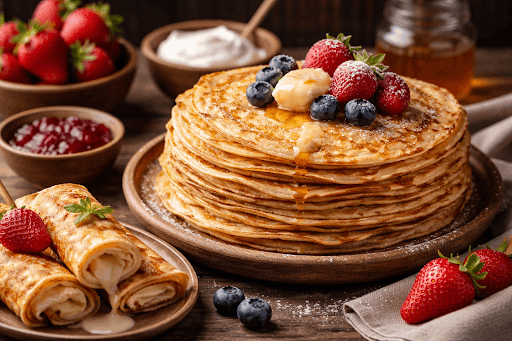
A pancake lies on your plate—modest, golden, smelling of childhood and butter. Don’t be fooled. It’s one of the oldest gastronomic tricksters in human history. Its age? Around seventy thousand years. Something resembling flat cakes made from ground plants and water was found in a Neanderthal cave.
It is older than agriculture, writing, and bronze. This is not breakfast. This is an artifact. And while civilizations were born and collapsed, it quietly evolved—from a prehistoric flatbread on a scorching rock to delicate lace on a cast-iron pan, absorbing myths, rituals, and the salt of countless generations.
A quick digest for those in a hurry:
- Its ancestors fed Neanderthals, and today it feeds you.
- The legendary “first pancake is lumpy” is the result of a centuries-long game of broken telephone with pagan spirits.
- It can be a funerary symbol, the centerpiece of spring festivities, street food, or a dish worth a thousand euros.
- Its physics are simple: hot metal + correct consistency = culinary magic.
- It united the world: every culture has its version, but only the Slavs made it a cult.
The Accidental Sun: How Forgetfulness Created a Cult
The story of the nation’s greatest culinary symbol began with a banal kitchen mishap. One version of its birth is completely lacking in solemnity: a careless housewife got distracted and left oat kisiel heating on the stove. The forgotten dish evaporated, browned, and crisped, turning into the first flatbread. Entirely by accident. Absolutely unintentional. Thus, from a dull mistake, the great pancake epic may have begun.
But archaeologists offer a far more epic beginning. In the Shanidar Cave in Iraq, traces of food about 70,000 years old were found. Neanderthals were already soaking and grinding grains, turning them into primitive dough and baking something like a proto-pancake on stones. This is not just an ancient dish—it may be one of the first prepared foods in human history, a contemporary of mammoths.
A Quiet Revolution in the Oven
Culinary history dates a more modest, but no less significant milestone to the years 1005–1006. That is when the first yeasted pancake appeared in Rus’, as the story goes. It was a genuine gastronomic revolution. Dough, animated by fermenting starter, began to rise, filling with air bubbles. From a flat unleavened cake it became that fluffy, tangy, living “sour pancake” we know today. It marked the shift from primitive food to a complex, soulful culinary phenomenon.
From that moment, it ceased to be merely food. The yeasted pancake—often buckwheat (called “red” for its color)—became a ritual object. It was baked in the oven—and the language is mercilessly precise: in Rus’, pancakes were truly “baked,” not “fried,” because in a Russian oven they were both grilled from below and baked from above by the heat of the vault.
This hot, breathing golden disk became the perfect metaphor for the sun. It was made for Maslenitsa—to summon spring. It was also eaten at funerals, as a symbol of the eternal cycle. It accompanied a person from birth (the postpartum mother was fed pancakes) to the final journey, closing the circle of being.
Thus, from an errant mishap or the oldest of necessities was born a dish that became interwoven into the very fabric of culture—an edible reflection of life’s core cycles.
The Pancake World Map: Globalization in Flour
The genius of the pancake lies in its architectural simplicity: flour, liquid, heat. This formula proved so victorious that dozens of cultures independently invented and adapted it. It makes the pancake the most successful culinary migrant in history.
- In France it became the refined crêpe—paper-thin, buckwheat or wheat-based, folded with ham and cheese or lemon and sugar.
- In England and the United States, it transformed into the thick, porous pancake, the cornerstone of a hearty breakfast drenched in syrup.
- In India, it reached a new level of fermentation: dosa, a giant crispy pancake of rice and lentils, serving as an edible plate for curry.
- In Ethiopia, fermented teff batter became injera—a tangy, spongy flatbread used to scoop stewed meat and vegetables.
- In Mexico, it found the name tortilla—an unleavened flatbread of corn or wheat, the basis of tacos, burritos, and enchiladas.
And yet, despite this international stardom, it was the Russian—and later East Slavic—tradition that endowed the pancake with existential depth. Here it is both holiday and everyday routine, both metaphysics and comfort. “A pancake is no wedge—it won’t burst your belly” is folk wisdom about its simplicity and satiation. It is democratic: eaten by princes and peasants alike. Rye for common folk; wheat for the festive table.
 Pancakes, the Beginning of Coziness
Classic milk pancakes are the basic recipe that never fails.
Beat 2–3 eggs with sugar and a pinch of salt, add room-temperature milk, gradually sift in flour, and stir until smooth. Finish by mixing in a little vegetable oil—so the pancakes won’t stick. The batter should be thin, like light cream. Bake on a well-heated pan until golden on both sides and brush with butter immediately.
Simple, thin, and truly homey!
The Sacred Technique: How to Tame the Pan
A classic Russian pancake is most often a story about yeast. Sponge starter, double proofing, that special faintly tangy aroma. But unleavened pancakes—blintsy—were also common. The formula is less about ingredients and more about ritual.
- The Pan. Cast iron, heavy, with low sides. It isn’t just washed—it’s seasoned with salt, then oiled before the first pancake (often with half an onion or a piece of lard).
- The Heat. The pan must be not just warm but scorching. Only then does the batter seize instantly and form those coveted tiny holes—the hallmark of a good pancake. No baking soda can achieve that; only temperature.
- The Motion. Batter is poured into the center—and at once, with a swift circular flick of the wrist, spread into a perfect circle. Excess drains back. This is a moment of pure physics and intuition.
- The Flip. When the edges begin to brown and pull away, and the surface turns matte—it's time. The spatula slides under one side, and the pancake is tossed. Catching it is the highest skill. A pancake dropped on the floor is considered dedicated to the house spirit.
Records and Absurdity: The Pancake as an Object of Obsession
Humanity couldn’t leave such a phenomenon without attempts at absolutism.
- Scale. In 1994, the UK produced a pancake over 15 meters across and weighing about 3 tons.
- Speed. The record for fast cooking: 1,092 pancakes in one hour.
- Sport. Since 1445, the English have held “pancake races”: women run while flipping pancakes in pans. The legend speaks of a housewife late for church who ran out holding the pan.
The pancake connects the Shanidar cave and your kitchen, the pagan ritual site and Orthodox Maslenitsa, everyday nourishment and festive revelry. It is the edible fragment of an eternal cycle: grain, mill, flour, fire, sun, life. It is simpler and more complex than it seems. And every time you tear off a hot, buttery piece, you are participating in a ritual thousands of years old. Just keep that in mind. And please, pass the sour cream.
-
 ReligionHoliday Prayer (Ṣalāt al-ʿĪd) in Islam: Structure, Symbolism, Significance
There arrives that singular dawn when the air seems to vibrate with quiet joy. Cities and villages still slumber, yet in Muslim homes lights begin to...
23 Jan 2026, 08:00 -
 ReligionBeginning the Day with Worship: On the Morning Prayer
Once, at the very break of dawn, when the world stood still in anticipation of the first ray of light, the Prophet Muḥammad (peace and blessings be up...
23 Jan 2026, 06:48 -
 ReligionNight Prayer: Finding Peace in the Silence of the Night
When the last rays of sunset fade and the world is covered in darkness, the time comes for the most mysterious of the obligatory prayers — the n...
23 Jan 2026, 06:02