



Beginning the Day with Worship: On the Morning Prayer
Once, at the very break of dawn, when the world stood still in anticipation of the first ray of light, the Prophet Muḥammad (peace and blessings be upon him) declared: “The one who prays before sunrise and before sunset shall never en...

Author
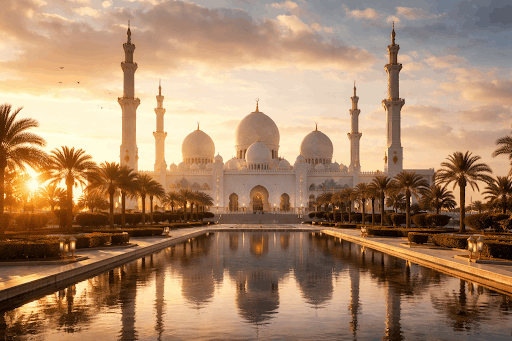
Once, at the very break of dawn, when the world stood still in anticipation of the first ray of light, the Prophet Muḥammad (peace and blessings be upon him) declared: “The one who prays before sunrise and before sunset shall never enter the Fire.” These words are not merely an instruction, but a promise—one of protection, enlightenment, and a special nearness that is born in those quiet moments when the sky begins to pale.
This is the time of Fajr, the morning prayer—the first of the five daily pillars upon which the believer’s day rests. It is not a mere ritual, but an encounter with the Creator, from which everything begins.
A Dialogue with Dawn: When the Sky Awakes
The time of Fajr constitutes a dialogue between night and day. It commences not at the call of an alarm clock, but at the command of heaven—marking the appearance of the true dawn, which spreads horizontally along the horizon as a thin band of radiant light, driving away the night.
Here one must be discerning, for there exists a deceptive glow known as the “false dawn”—a vertical column of light resembling a wolf’s tail which flashes briefly and vanishes. This does not signal the time of prayer. The true dawn, by contrast, unfolds horizontally along the edge of the earth: it is from this moment that the time of Fajr begins, and for the fasting person the time for eating ends. It is then that the Qur’ān proclaims: “Establish the prayer… and the Qur’ān at dawn.”
Times of Refrainment: When the Sun Bears Witness
Yet this dialogue also contains pauses. The Prophet (peace and blessings be upon him) identified three periods during which prayer is forbidden: at sunrise, when the sun’s disk ascends above the horizon; at zenith, when it stands at its highest point; and at sunset, as it descends. In antiquity, these were moments of pagan solar worship. For the Muslim, however, they become moments of silent contemplation—a reminder that worship belongs to the Creator, not to His creation.
But what of places where dawn itself becomes uncertain—lands of the “white nights,” where the sun barely sets, or in the far north? Scholars propose two permissible methods: to approximate the times by reference to Mecca, or by adopting the schedule of the nearest region in which day and night follow their ordinary rhythm. Both approaches are valid, preserving the possibility of worship in every corner of the earth.
If One Oversleeps…
There are times when the sweetness of sleep overcomes noble intention. Yet the mercy of God is boundless. The Messenger (peace and blessings be upon him) taught: “Sleep is not negligence. Thus, if one forgets a prayer or oversleeps, let him perform it when he remembers.” Even if one awakens as the sun begins to rise, one hastens to make up the missed prayer. Whoever completes even one rakʿah before sunrise is deemed to have performed the Fajr on time.
 How to Perform Fajr: Step by Step, from Heart to Heaven
The morning prayer resembles a light yet precise choreography of devotion. It consists of two units (rakʿahs) of Sunnah and two of Farḍ. The Prophet (peace and blessings be upon him) cherished the two Sunnah rakʿahs to such an extent that he never omitted them, even during travel.
It begins with a pure inward intention, followed by the takbīr — “Allāhu Akbar,” announcing the commencement of the encounter. The hands are folded in prayer, and the first words of glorification are pronounced: “Glory be to You, O God…” The recitation of Sūrat al-Fātiḥah forms the foundation, after which one may recite additional Qur’ānic verses—for example Sūrat al-Ikhlāṣ, which proclaims the oneness of God.
Then follows the bowing (rukūʿ), where the believer exalts the majesty of the Lord. Rising, he affirms: “God hears those who praise Him.” The prostration (sujūd) represents the highest act of humility, as the forehead touches the earth with the words: “Glory be to my Lord Most High.” The sequence is repeated in the second rakʿah and concludes with the testimony of faith (“Ashhadu an lā ilāha illā Allāh…”), salutations upon the Prophet, and a humble supplication to the Most High.
The Farḍ prayer follows the same form, distinguished only by its obligatory status. Men and imāms recite al-Fātiḥah and additional verses aloud, for Fajr is among those prayers in which the Qur’ān is proclaimed openly, sharing its light with others.
Beginning the Day with a Conversation
The morning prayer is more than a duty; it is an opportunity—an opportunity to begin the day not with chaos, but with stillness; not with anxiety, but with peace; not in isolation, but in dialogue with the One who knows all things.
It grants a unique vitality—not merely bodily alertness, but clarity of soul. It sets the compass for the day ahead, for “truly, prayer restrains from immorality and wrongdoing.”
So the next time you witness the eastern sky begin to lighten, remember—this is not merely a physical phenomenon. It is an invitation: to rise, to purify oneself, and to enter into that sacred dialogue at dawn—promised to those who seek the light, and which, by God’s mercy, never remains unanswered.
-
 Culinary RecipesEveryone’s Favorite Pancakes: an Interesting History and a Classic Recipe
A pancake lies on your plate—modest, golden, smelling of childhood and butter. Don’t be fooled. It’s one of the oldest gastronomic t...
23 Jan 2026, 11:24 -
 ReligionHoliday Prayer (Ṣalāt al-ʿĪd) in Islam: Structure, Symbolism, Significance
There arrives that singular dawn when the air seems to vibrate with quiet joy. Cities and villages still slumber, yet in Muslim homes lights begin to...
23 Jan 2026, 08:00 -
 ReligionNight Prayer: Finding Peace in the Silence of the Night
When the last rays of sunset fade and the world is covered in darkness, the time comes for the most mysterious of the obligatory prayers — the n...
23 Jan 2026, 06:02