



Solve the Rubik’s Cube from Scratch: A Method That Never Fails
Almost everyone has, at least once in life, held this colorful puzzle, rotated its faces in powerless hope for a miracle, and finally consigned it to a distant shelf—where it quietly gathers dust beside an unfinished jigsaw puzzle and...

Author
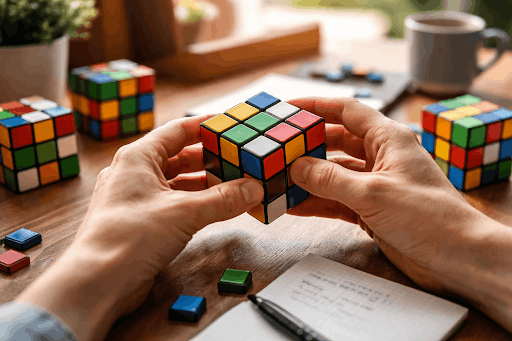
Almost everyone has, at least once in life, held this colorful puzzle, rotated its faces in powerless hope for a miracle, and finally consigned it to a distant shelf—where it quietly gathers dust beside an unfinished jigsaw puzzle and a broken remote-controlled toy car.
We watch speedcubers flick through the cube in ten seconds and think: “Their brains must be cosmic computers—or their cubes must be enchanted.” Yet the truth is simple: solving a Rubik’s Cube is not a matter of genius. It merely requires grasping a straightforward, almost childlike logic and shedding one’s fear.
It is much like riding a bicycle: until you actually sit down and try, it seems like sorcery—some mysterious equilibrium of forces. Once mastered, however, you ride one-handed, then no-handed, and ask questions such as “How do you do that?” become faintly irritating.
A small spoiler: after twenty minutes with this article, you will understand how to solve a Rubik’s Cube. No superpowers, no advanced mathematics—just you, this colorful piece of plastic, and a handful of memorable movements affectionately known as the “Pif-Paf.”
Not a Cube, but a Construction Set: What This Thing Is Really Made Of
Let us dispel the first misconception immediately. You are not moving stickers; you are moving solid mechanical elements, much like components of a construction set. There are only three kinds:
- Centers (6 pieces). These are the fixed middle elements on each face. They never change position relative to one another. If the white center is facing you, the yellow center will always be on the opposite side. They constitute the axes of rotation—immovable beacons amid chromatic chaos.
- Edges (12 pieces). These are rectangular blocks with two colors, for example, a red-and-white edge.
- Corners (8 pieces). These have three colors, for example, a blue-white-red corner.
Here lies the entire “secret” of solving the cube: one must place each corner and each edge into its correct position, such that its colors align with the surrounding centers. That is all—no mysticism involved.
A Notation Simpler than Japanese: The Language of Turns
To avoid writing epic novels such as “turn this face in this fashion, then that one in that fashion,” clever people devised a compact notation based on English names of faces:
- R — Right
- L — Left
- U — Up
- D — Down
- F — Front (the face toward you)
- B — Back
If the letter stands alone (e.g., R), rotate that face clockwise as if you were looking directly at it.
If it is marked with an apostrophe (R'), rotate it counter-clockwise.
If it bears a 2 (R2), rotate it 180 degrees (two quarter turns).
So R is “tighten the lid,” and R' is “loosen the lid.” That is nearly the entire science.
Your Principal Weapon: The “Pif-Paf” Algorithm
Forget elaborate 20-move formulas. The entire beginner’s method rests upon a remarkably simple four-move sequence:
R U R' U'
Say it aloud: “Right clockwise, Up clockwise, Right counter-clockwise, Up counter-clockwise.”
Rotate the cube accordingly a few times. This is the Pif-Paf—your faithful ally. It moves corners without disturbing the already-solved portions. Commit it to muscle memory.
The Way of the Samurai: Seven Stages from Chaos to Order
We shall solve the cube layer by layer, like a tiered cake. And yes—the first “layer” is the most consequential.

Stage 1: The Correct White Cross (Not the Way Most Beginners Do It)
It is insufficient merely to form a white cross on the white face. One must form a correct cross: each white edge must continue down its side, aligning with its corresponding side center. A white-and-red edge must sit between the white and red centers.
How is this done?
First construct a “daisy”—all white edges arranged around the yellow center. Then, one by one, align each edge with its side center and lower it into position. This process is best understood intuitively through experimentation.
Stage 2: White Corners and Completion of the First Layer
Turn the cube so the white cross is on the bottom—your foundation layer. Your task is to insert the four white corners. Look at the top layer: find a white corner, position it above its intended destination (between matching centers), and then observe where the white sticker lies:
- If it faces the side — perform one Pif-Paf
- If it faces upward — perform three Pif-Pafs
- If it faces you — perform five Pif-Pafs
Do not fear the number five; it is simply repetition of the same motion. When finished, the corner will neatly slide into place. Repeat for all four. Voilà—you now possess a completed first layer.
Paradoxically, the more Pif-Pafs you perform here, the faster you will ultimately complete the stage—provided you resist the urge to constantly re-grip the cube.
Stage 3: The “Belt,” or the Second Layer
Now we must place four edges into the middle layer (the ones without yellow). Locate such an edge on the top, rotate the top (U) to match its side color with its center, and determine whether it “descends” left or right.
You will need a pair of algorithms: the basic Pif-Paf, and its mirrored “left Pif-Paf” (L' U' L U). Their combination depends on direction, and with minimal practice becomes as natural as a two-step dance.
Stage 4: The Yellow Cross on the “Ceiling”
Invert the cube: the yellow center is now atop. We require a yellow cross. You may see merely a dot, an “L” shaped corner, or a straight line. Regardless, the single algorithm is:
F R U R' U' F'
- For a dot — perform it three times
- For an “L” — twice
- For a line — once
Occasionally the cross appears by itself—smile graciously at your good fortune.
Stage 5: Positioning Yellow Corners (Ignoring Their Orientation)
At this stage the corners may not yet occupy their proper places. We want each to hover above its designated “slot.” Use the corner-permutation formula:
R U' L' U R' U' L U
If one corner is already correctly placed, position it at the front-left and apply the formula 1–2 times until all corners are correctly positioned. If none are correct, apply the formula once from any orientation; one correct corner will emerge, after which proceed as above.
Stage 6: Orienting the Yellow Corners (The Moment When Everything Appears Ruined)
Attention! This is the most psychologically challenging phase.
Hold the cube so that the unsolved yellow face is on your left (not on top!). The front-right corner will now be the one requiring rotation. Perform the familiar Pif-Paf (R U R' U') repeatedly until that corner’s yellow sticker faces upward.
At this point the rest of the cube will appear disastrously scrambled. Do not panic. Do not change your grip. Simply rotate the left face to bring the next unsolved corner into the front-right position and repeat the process. Do this for all four corners.
Once the final corner is oriented, the entire cube will miraculously resolve itself. It is a small rite of passage: one must endure temporary chaos to attain order.
A humorous note: it is said that 90% of novices abandon the cube at precisely this juncture, convinced they have destroyed it. Yet 100% of those who persist rejoice shortly thereafter, cube solved in hand.
And then comes the moment of truth: six solid faces. You have done it—not as a genius or a magician, but simply as a person who understood the system.
This guide is not a ticket to the World Championship in speedcubing. It is a key to a door long assumed locked. Beyond it lie faster crosses, advanced methods like Fridrich with 120 algorithms, or simply the leisurely pleasure of turning the cube to relieve stress.
The crucial lesson is this: you now know. And knowledge, in this case, revolves around four simple moves—Right, Up, Right back, Up back—your personal Pif-Paf against any complexity.
-
 Culinary RecipesEveryone’s Favorite Pancakes: an Interesting History and a Classic Recipe
A pancake lies on your plate—modest, golden, smelling of childhood and butter. Don’t be fooled. It’s one of the oldest gastronomic t...
23 Jan 2026, 11:24 -
 ReligionHoliday Prayer (Ṣalāt al-ʿĪd) in Islam: Structure, Symbolism, Significance
There arrives that singular dawn when the air seems to vibrate with quiet joy. Cities and villages still slumber, yet in Muslim homes lights begin to...
23 Jan 2026, 08:00 -
 ReligionBeginning the Day with Worship: On the Morning Prayer
Once, at the very break of dawn, when the world stood still in anticipation of the first ray of light, the Prophet Muḥammad (peace and blessings be up...
23 Jan 2026, 06:48