



2026 - the year when March liberates you from the office chair
If you are reading this in the hope of finding a dry list of numbers and dates, we have disappointing news for you: you have come to the wrong door. That material exists elsewhere, in official documents. What you will find here is a narrati...

Author
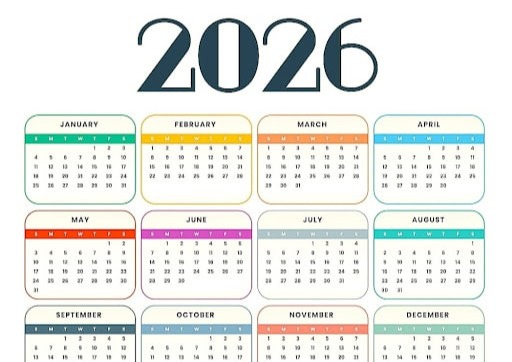
If you are reading this in the hope of finding a dry list of numbers and dates, we have disappointing news for you: you have come to the wrong door. That material exists elsewhere, in official documents. What you will find here is a narrative. A story about how a single 365-day calendar can become your personal strategic plan for extracting the maximum number of sunny, free, and genuinely beautiful hours from the eternally hungry monster known as Work.
2026 is not merely another year.
It is a mathematically calibrated framework for rest.
241 working days versus 107 weekends and 19 public holidays.
At first glance, this seems like a respectable balance. As is often the case, however, everything depends on the details. And in this instance, the details are called March—that very March: generous, unpredictable, and delightfully unhinged in its own way.
The March marathon: when weekends arrive in convoy
Remember these dates: March 20–24. Five days. Five.
This is Nowruz, a time traditionally devoted to visiting relatives and to the highest form of productive inactivity. Yet 2026 goes further, adding a bonus: Ramadan begins on March 20–21.
The result is a spectacular overlap: the start of Ramadan coincides with the opening days of Nowruz.
A small insider’s note: precisely because of this calendrical sleight of hand, additional days off appear on March 9, 25, 26, 27, and 30 (for those on a five-day workweek). It is as if you worked briefly at the beginning of the month and then drifted into an almost two-week voyage through holidays and transferred days off.
March 2026 is not a month; it is a vacation enclave embedded within the year.
A number with a sense of irony
1,922 hours. That is how much time you are expected to spend at work over the year (on average, with a 40-hour workweek). It sounds epic—almost like the date of a great historical battle. In essence, it is precisely that: your personal battle for balance.
Spread across 241 working days, however, this reduces to a familiar figure: 8 hours per day. Merely eight hours, exchanged for the luxury of full weekends—or for the legendary March marathon itself.
Not only March: where else freedom hides
The year neither begins nor ends with March alone.
The traditional winter opening move: December 31 (Day of Solidarity) flows seamlessly into January 1–2. Add Saturday and Sunday, and you have an ideal five-day New Year stretch.
Spring and summer are equally generous:
May brings Victory Day over Fascist Germany (May 9), followed by a double festive table: Independence Day of Azerbaijan (May 28) and Gurban Bayram (May 27–28).
Note carefully: in 2026, May 28 is a double holiday. This means one day off is effectively “borrowed” and returned later through a transferred rest day.
June contributes to National Salvation Day (June 15) and Armed Forces Day (June 26).
Victory Day in the Second Karabakh War (November 8), State Flag Day (November 9), and, of course, January 20 — the Day of National Mourning. This day is removed from the working calendar, yet permanently inscribed in history.
Mechanics, life hacks, and what “a transferred day off” really means
This is the most important section. The state does not merely distribute holidays; it plays a logical game with the calendar.
The rules are as follows:
- If a public holiday falls on a Saturday or Sunday (already a legal day off), it is not met with regret but compensated by a rest day on the nearest working day.
- A special case applies to Gurban Bayram and Ramadan. When they coincide with other holidays (as in March 2026), the day off is likewise transferred. This is precisely why additional free days appear in March, May, and November.
A strategist’s memo
- Where to look in March 2026? It dates from the 20th onward. Stock up on patience—and sweets.
- What does “shortened working day” mean? On the eve of holidays and on January 20, the working day is reduced by one hour. A small but pleasant concession from the universe.
- What if I work a six-day week? The principle remains the same: the total annual workload is still 1,922 hours. Your weekdays will be denser, but the long weekends remain yours.
Your 2026 is more than a sequence of dates
It is an opportunity. An opportunity to plan vacations that feel endless by skillfully attaching them to holidays. An opportunity to know in advance when to stock the table—and when to book tickets to warmer climates. An opportunity to prepare psychologically for the most demanding periods, so that you move through them with a smile, already anticipating the next “island of freedom.”
The production calendar is not a bureaucratic formality. It is a treasure map for the year ahead. Where the X does not mark buried gold, but the days when you can exhale, embrace loved ones, remember what matters, or simply lie on the sofa without a trace of guilt.
Judging by the layout, 2026 will be generous. All that remains is to use it wisely.
So save this cheat sheet. Mark the dates in your planner—not your work planner, your personal one. And prepare yourself—especially for that legendary March. It is worth it.
-
 Culinary RecipesEveryone’s Favorite Pancakes: an Interesting History and a Classic Recipe
A pancake lies on your plate—modest, golden, smelling of childhood and butter. Don’t be fooled. It’s one of the oldest gastronomic t...
23 Jan 2026, 11:24 -
 ReligionHoliday Prayer (Ṣalāt al-ʿĪd) in Islam: Structure, Symbolism, Significance
There arrives that singular dawn when the air seems to vibrate with quiet joy. Cities and villages still slumber, yet in Muslim homes lights begin to...
23 Jan 2026, 08:00 -
 ReligionBeginning the Day with Worship: On the Morning Prayer
Once, at the very break of dawn, when the world stood still in anticipation of the first ray of light, the Prophet Muḥammad (peace and blessings be up...
23 Jan 2026, 06:48