



Night Prayer: Finding Peace in the Silence of the Night
When the last rays of sunset fade and the world is covered in darkness, the time comes for the most mysterious of the obligatory prayers — the night prayer, ‘Isha. It forms a bridge between the noise of the day and the calm of t...

Author
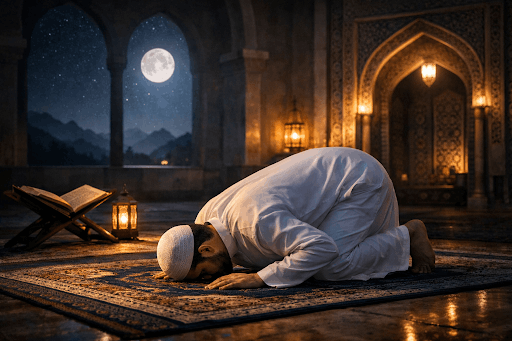
When the last rays of sunset fade and the world is covered in darkness, the time comes for the most mysterious of the obligatory prayers — the night prayer, ‘Isha. It forms a bridge between the noise of the day and the calm of the night, a moment when a believer is left alone with their Creator.
When the echoes of the day subside and night settles upon the earth, a special time begins for a Muslim. This is the time of the ‘Isha prayer — the fifth and final obligatory prayer that completes the day and prepares the heart for the coming night’s rest. It is not merely a ritual, but a sincere dialogue, an intimate conversation between a servant and their Lord in the stillness and quiet of the night.
In this article, we will not simply list actions, but walk through the entire journey together — from the intention in the heart to the concluding salam, feeling the inner logic and beauty of this act of worship.
A Time for Silent Dialogue: When to Pray ‘Isha?
The time for the night prayer does not begin when it gets dark, but immediately after the time of the Maghrib prayer ends. And when does it end? Scholars differ on this point, and it is important to know this.
According to the strongest opinion based on direct hadith evidence, the time for ‘Isha lasts until the middle of the night (Islamic or “shar‘i” midnight).
Other scholars say that the time extends until the true dawn (Fajr).
How to calculate Islamic midnight?
It is not 12:00 a.m. by the clock. In Islam, the night begins at sunset (Maghrib) and ends at dawn (Fajr). To find its midpoint:
- Determine the duration of the night (from sunset to dawn).
- Divide that interval in half.
- Add the resulting value to the sunset time.
Interestingly, according to the Sunnah, it is recommended to delay ‘Isha slightly if this does not cause hardship for those praying. The Prophet Muhammad (peace and blessings be upon him) said that if he did not fear burdening his community, he would have ordered them to delay this prayer until the first third or even the middle of the night.
However, if the prayer is performed in congregation, offering it at the beginning of its time with the group is preferable to praying it later alone.
Structure of the Night Worship: Three Stages
The ‘Isha prayer consists of not one, but three consecutive prayers. Their order is fixed and symbolizes the gradual calming of the soul before sleep:
- Four rak‘ahs of fard (obligatory part)
- Two rak‘ahs of sunnah (recommended part regularly practiced by the Prophet ﷺ)
- Three rak‘ahs of witr (necessary prayer, close to obligatory)
A unique aspect of ‘Isha is that the first two rak‘ahs of the fard are recited aloud (for men praying alone or an imam leading the prayer). The third and fourth rak‘ahs, as well as all sunnah prayers, are recited silently.
Step by Step: A Journey Through the Four Rak‘ahs of the Fard
First Rak‘ah: The Beginning
- Intention (niyyah). In the heart or quietly:
“I intend for the sake of Allah to perform four rak‘ahs of the obligatory night prayer ‘Isha.” - Opening takbir (takbir al-ihram).
Action: Raise the hands to the level of the ears (men) or chest (women), palms facing the Qiblah.
Words: Say “Allahu Akbar” (Allah is the Greatest), marking the start of the prayer. - Standing (qiyam).
Place the hands on the abdomen (men) or on the chest (women). Recite: - The opening supplication (du‘a as-Sana) “Subhanaka Allahumma...”
“A‘udhu billahi...” (seeking refuge from Satan)
“Bismillahir-Rahmanir-Rahim” - Recitation (qira’ah).
Recite Surah Al-Fatiha (aloud). At the end say “Amin” quietly.
Then recite any short surah or several verses, for example Surah Al-Kawthar (aloud). - Bowing (ruku‘).
Say “Allahu Akbar” and bow, placing hands on the knees. Repeat three times:
“Subhana Rabbiyal-‘Azim” (Glory to my Great Lord). - Rising.
While rising say: “Sami‘allahu liman hamidah” (Allah hears those who praise Him).
Once upright: “Rabbana wa lakal-hamd” (Our Lord, to You is all praise). - Prostration (sujud).
Say “Allahu Akbar” and prostrate, touching the ground with knees, hands, then forehead and nose. Repeat three times:
“Subhana Rabbiyal-A‘la” (Glory to my Most High Lord). - Brief sitting.
Say “Allahu Akbar” and sit on the left foot with the right foot upright. Here one may say:
“Rabbi-ghfir li...” (My Lord, forgive me...). - Second prostration.
Perform a second sujud, repeating the same words.
Second Rak‘ah: Deepening the Prayer
Stand with “Allahu Akbar” for the second rak‘ah.
Everything is repeated as in the first. For recitation after Al-Fatiha, you may recite another short surah, for example Al-Ikhlas.
Key difference: after the second sujud, remain seated and recite the Tashahhud (At-Tahiyyat).
After finishing, stand for the third rak‘ah with “Allahu Akbar”.
Third and Fourth Rak‘ahs: The Peak of Humility
A notable simplification here: after “Bismillah”, only Surah Al-Fatiha is recited (silently).
All other actions are the same.
After the second sujud of the fourth rak‘ah, sit again to recite:
- At-Tahiyyat
- Salawat on the Prophet ﷺ
- The supplication “Rabbana”
Conclusion (taslim).
Turn the head to the right saying:
“As-salamu ‘alaykum wa rahmatullah.”
Then to the left repeating the same words. The fard part is now complete.
Additional Stages: Sunnah and Witr
Two rak‘ahs of Sunnah.
Performed right after the fard, as a separate short prayer. The sequence mirrors the first two rak‘ahs of the fard, but everything is recited silently.
Intention: “…to perform two rak‘ahs of the Sunnah of the night prayer.”
Three rak‘ahs of Witr.
This is the final prayer of the night. It may be performed immediately or delayed until the last third of the night. Most commonly it is prayed as:
Two rak‘ahs + one rak‘ah (with taslim between them)
In the last rak‘ah, after Al-Fatiha and another surah, the special Qunut supplication is recited (with raised hands), seeking forgiveness and blessings from Allah.
What If the Prayer Is Missed?
Life is unpredictable. One may oversleep or forget. The key is not to despair. If a Muslim misses the ‘Isha prayer — whether due to a valid excuse (sleep, forgetfulness) or without one — they should make it up as soon as they remember or have the opportunity. This serves as atonement and a return to the path of worship.
More Than a Ritual: Why Is ‘Isha So Important?
The night prayer is more than an obligation. It is an opportunity to reflect on one’s day, thank for blessings, and seek forgiveness for mistakes. It is a spiritual “reset” before sleep.
In one hadith, the Messenger of Allah ﷺ once delayed ‘Isha until a significant part of the night had passed, and after praying he said:
“Indeed, this is the real time for this prayer, if I did not fear burdening my followers.”
This prayer wipes away the sins of the day, brings tranquility, and becomes a light in the believer’s grave. Through it, we end our day not overwhelmed by worries, but in a state of peace, gratitude, and connection with Allah.
 What Is the Difference Between Men and Women?
- Hand placement: men place their folded hands below the navel, women on the chest.
- Postures: women adopt more compact positions, keeping elbows closer and drawing the body inward during sujud.
- Recitation volume: men recite the first two rak‘ahs aloud when praying alone or as imam; women always recite silently.
The night prayer ‘Isha is a quiet harbor at the end of a long day — a moment when the noise fades and conscious worship comes forward. It is your personal conversation with the Creator, bringing forgiveness, tranquility, and preparing you for peaceful sleep and a new day.
May every ‘Isha of yours be filled with sincerity, humility, and hope for the mercy of the Most High.
-
 Culinary RecipesEveryone’s Favorite Pancakes: an Interesting History and a Classic Recipe
A pancake lies on your plate—modest, golden, smelling of childhood and butter. Don’t be fooled. It’s one of the oldest gastronomic t...
23 Jan 2026, 11:24 -
 ReligionHoliday Prayer (Ṣalāt al-ʿĪd) in Islam: Structure, Symbolism, Significance
There arrives that singular dawn when the air seems to vibrate with quiet joy. Cities and villages still slumber, yet in Muslim homes lights begin to...
23 Jan 2026, 08:00 -
 ReligionBeginning the Day with Worship: On the Morning Prayer
Once, at the very break of dawn, when the world stood still in anticipation of the first ray of light, the Prophet Muḥammad (peace and blessings be up...
23 Jan 2026, 06:48