Tayammum: A Mercy from God and a Path to Purity Without Water
Amid the rhythm of modern life and the comforts of civilization, we rarely pause to reflect on the simplicity and wisdom embedded in Islamic teachings. One of the greatest manifestations of Divine compassion toward His servants is tayammum...

Author
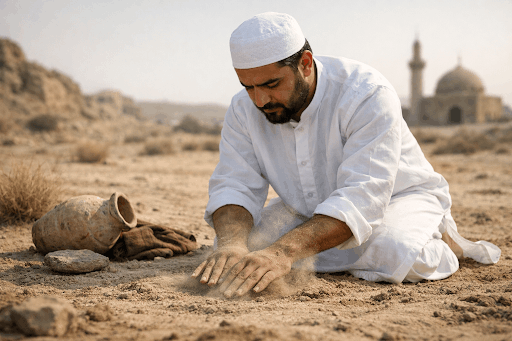
Amid the rhythm of modern life and the comforts of civilization, we rarely pause to reflect on the simplicity and wisdom embedded in Islamic teachings. One of the greatest manifestations of Divine compassion toward His servants is tayammum (literally meaning “intention”)—a form of purification using clean earth permitted in circumstances where the use of water is impossible or harmful.
This allowance is not merely a convenience; it is a sign that God desires ease for us and does not will hardship. It reminds us that worship—our essential bond with the Creator—is never interrupted by circumstance.
Basis in Revelation
The right to perform tayammum has been granted to us directly by God in a clear verse of the Noble Qur’an:
“…And if you are ill, or on a journey, or if one of you comes from relieving himself, or you have had intimate relations with your wives, and you cannot find water, then perform tayammum with clean earth, and wipe your faces and hands with it. Truly, God is Ever-Forbearing, All-Forgiving” (Qur’an 5:6).
These words serve as direct guidance and consolation for any believer who finds themselves in constrained circumstances. The Prophet Muhammad (peace and blessings be upon him) also highlighted the greatness of this mercy when he said: “The entire earth has been made for me and my community as a place of prayer and as a means of purification.”
When is Tayammum Permitted?
Islamic law—combining unchanging principles with flexible application—clearly outlines situations in which earth may replace water:
- Physical absence of water: When, after sincere searching, there is no sufficient water within approximately 1.8–2 km (one Islamic mile).
- Illness or threat to health: When using water could cause harm—aggravating illness, delaying healing, causing hypothermia, or inducing new illness. It is narrated that the Companion Amr ibn al-As performed tayammum on a cold night out of fear for his life, and the Prophet (peace be upon him) approved of his action.
- Water needed for survival: When the limited available water is required for drinking or preparing food for humans or animals.
- Real danger: When the path to water poses a threat to life, health, or property—due to enemies, wild animals, or natural hazards.
- Inability to use accessible water: For example, water present in a well but with no means to draw it, or water belonging to another person who refuses to sell or share it.
It is vital to understand that tayammum is a permitted concession (rukhṣa), not a routine alternative. The obligation to use water resumes as soon as its use becomes possible.
How It Is Performed: Simplicity with Intention
The performance of tayammum is marked by profound symbolic simplicity. It includes only two obligatory components (farāʾiḍ): wiping the face and wiping the hands up to and including the elbows.
Prescribed procedure:
- Sincere intention (niyyah): One affirms inwardly the intention to perform tayammum in order to lift a state of ritual impurity and enable acts of worship. Unlike ablution with water, intention is obligatory here, as the earth becomes a means of purification only through God’s will and our conscious turning toward Him.
- Invocation of God’s Name: Saying “Bismillāh ar-Raḥmān ar-Raḥīm.”
- First strike of the palms: Lightly striking the palms on a clean surface of earth, sand, stone, or dust (not polluted).
- Wiping the face: After shaking off excess dust, wiping the entire face once with the inner side of both hands.
- Second strike of the palms.
- Wiping the hands: Wiping the right hand (fingertips to elbow) with the left palm, then the left hand in the same manner with the right palm.
Thereafter, tayammum is complete and the individual may perform obligatory and voluntary prayers, recite the Qur’an, and engage in acts of worship until tayammum is invalidated.

What Invalidates Tayammum?
Tayammum is nullified by two main factors:
- Anything that invalidates ablution (wuḍūʾ) or ritual bathing (ghusl): such as bodily excretions, deep sleep, etc.
- Disappearance of the cause for which it was performed: availability of water, recovery from illness, removal of danger, and so forth.
Frequently Asked Questions
1. “If water is found after praying with tayammum, must the prayer be repeated?”
No. Authentic reports indicate that the prayer is valid. One who repeated the prayer out of caution would receive double reward.
2. “May one perform tayammum if water is available but one fears missing the congregational prayer?”
For ordinary obligatory prayers—no; wuḍūʾ should be performed even if one arrives late, and the missed prayer made up.
An exception exists for the Eid and funeral (janāzah) prayers, which are not made up; in risk of fully missing them, some jurists permit tayammum.
3. “What materials may be used besides soil?”
Any clean natural substance of earthly origin: sand, stone, clay, limestone. Clean dust gathered on a surface (wall, cloth) is also valid. Metals or substances that melt or burn are not suitable.
4. “What if a person is unable to perform either ablution or tayammum?”
In such an extreme case, one prays as they are, for “God does not burden a soul beyond its capacity” (Qur’an 2:286).
Conclusion: Wisdom in Every Particle of Dust
Tayammum is not merely a ritual. It recalls our primordial nature, created from earth. It teaches humility and trust in the Most Merciful. It testifies to the universality of Islam—a religion suited for every time, place, and circumstance, always providing the believer with a clear path to Divine favor.
In this ordinance lies a profound wisdom that turns the very soil beneath our feet into a key to spiritual purity, granted to all who sincerely seek the Countenance of God.
-
 Culinary RecipesEveryone’s Favorite Pancakes: an Interesting History and a Classic Recipe
<p dir="ltr"><span style="font-size: 18px;">A pancake lies on your plate—modest, golden, smelling of childhood and butter. Don’t be fooled...
23 Jan 2026, 11:24 -
 ReligionHoliday Prayer (Ṣalāt al-ʿĪd) in Islam: Structure, Symbolism, Significance
<p dir="ltr"><span style="font-size: 18px;">There arrives that singular dawn when the air seems to vibrate with quiet joy. Cities and villages still s...
23 Jan 2026, 08:00 -
 ReligionBeginning the Day with Worship: On the Morning Prayer
<p dir="ltr"><span style="font-size: 18px;">Once, at the very break of dawn, when the world stood still in anticipation of the first ray of light, the...
23 Jan 2026, 06:48