



Capybara: the Barrel-Shaped Rodent That Has Cancelled Your Anxiety
The world has gone mad. You feverishly pursue tranquility in meditation, expensive therapists, and eco-retreats. Yet serenity has long existed, fully invented and perfected. It resembles a cross between a hippopotamus and a plush toy, and i...

Author
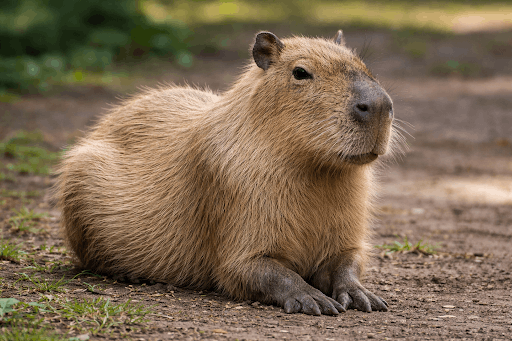
The world has gone mad. You feverishly pursue tranquility in meditation, expensive therapists, and eco-retreats. Yet serenity has long existed, fully invented and perfected. It resembles a cross between a hippopotamus and a plush toy, and its life philosophy is: “swim, chew, do not exert yourself.”
Behold the capybara— the giant water pig that, without uttering a word, offers a master class in the art of living.
This is not merely an animal. It is a slow-moving guru and the undisputed champion of the relaxed worldview. While you panic about deadlines, it chews grass in the marshes of Venezuela, graciously allowing birds to host picnics on its back.
Part I: An Appearance That Declares “YOU CANNOT CATCH ME”
Officially it is Hydrochoerus hydrochaeris, “the water pig.” Unofficially, it is an ambulatory (indeed, aquatic) paradox. It belongs to the order Rodentia—the very group that gave the world timid mice and nimble rats.
Yet the capybara is the rodent that devoured all rivals in the size category: up to 1.5 meters in length, up to 65 kilograms in weight. Certain females approach a full quintal. Imagine your household guinea pig suddenly growing to the size of a spaniel and acquiring the gaze of a sage.
Fact Block: A Church Scandal
In the 18th century Catholic theologians agonized over a dilemma: could one consume capybara meat during Lent? The resolution was ingenious in its absurdity— the animal was declared… a fish. Yes, this furry herbivorous “barrel” became ichthyofauna for nearly a century. Logic, as ever, is capricious.
Its body is barrel-shaped; there is no tail; the feet have webbing for efficient swimming. The fur is coarse, like a brush, so that water slides off easily. But the true signature is the face. An English naturalist once likened its expression to that of a contemplative lion. The gaze is heavy, calm, and all-understanding. It looks at you, and suddenly your troubles feel trivial. Its orange incisors grow throughout life— if it stops gnawing, the teeth will eventually penetrate the skull. Such is evolution’s uncompromising motivation toward vegetarianism.
Part II: A Capybara’s Guide to the Ideal Life
Its world revolves around water. Not merely “fond of swimming”—water is its bar, spa, dining hall, bridal suite, and fortress. It dives with ease, holding its breath for five minutes. The eyes, ears, and nostrils are clustered atop the head, allowing it to submerge almost fully while continuing to observe. An ideal design for one who prefers avoiding problems rather than solving them.
Capybaras live communally. A typical group consists of one dominant male, a harem of females, and the young. Approximately 10% of males become outcasts who roam the periphery. Territory is marked with scented secretions—unromantic but effective.
Their schedule:
- Dawn: unhurried breakfast of shoreline grasses.
- Midday: obligatory spa session—retreating into water or cool mud (they lack underfur and can sunburn).
- Evening: a second feeding session.
- Night: brief sleep on the ground. They do not dig burrows. Sometimes they sleep sitting, like a meditative dog.
Acoustic repertoire:
The capybara is a master communicator. Its lexicon includes barking (alarm!), squealing (danger near!), chirping (all is well), and teeth-chattering (keep your distance). In captivity they may whimper for treats. It is essentially a chat room conducted through grunts—and it functions beautifully.
Part III: The Dark Side of the Idyl
The diet is strictly plant-based: up to 3.5 kg of grasses, water hyacinth, bark, and fruits per day. They may raid plantations, which does not endear them to farmers. Yet there is a detail omitted in cute postcards:
They practice coprophagy. Yes, capybaras eat their own feces— not from hunger but physiological necessity. This allows them to break down stubborn cellulose and obtain B vitamins. A morning ritual. Nature is not obligated to be sentimental.
Reproduction is efficient rather than romantic. A female is fertile for only eight hours every few months. During that time she may be mounted up to 20 times—sometimes by multiple males. Gestation lasts five months. Litters of 2–8 pups are born fully sighted and toothed. The entire female collective immediately assumes childcare duties. They nurse for up to four months, but begin grazing from day one.
There are predators (jaguars, anacondas, caimans), but the defensive tactic is simple: dive and disappear. It usually succeeds. In the wild they live up to 10 years; in captivity up to 12.
Part IV: From Swamp to the Summit of Pop Culture
How did this ungainly creature become iconic?
- Japan, 1980s. The first capybaras were placed in hot-spring enclosures (onsen). Photos of serene rodents steaming in baths went viral. Later came the anime character Capybara-san—a languid philosopher. The Japanese, connoisseurs of kawaii aesthetics, were enthralled.
- Internet boom, 2020s. Thousands of videos showed capybaras placidly coexisting with birds, monkeys, even crocodiles (often mutually indifferent). Add the viral “Capybara Song.” They became symbols of imperturbability. The meme “The capybara does not worry” became a generational motto.
- The Argentine Uprising, 2020. During lockdown, a thousand capybaras invaded Nordelta, an elite suburb built on drained wetlands. They strolled empty streets, grazed immaculate lawns, and were hailed as emblems of nature’s revenge.
Part V: Want One at Home? Read This First.
Yes, they are genuinely good-natured, walk politely on a leash, and coexist peacefully with cats and dogs. But their husbandry is demanding. An apartment is unsuitable—they require a private home with a pond or pool because they spend up to twelve hours per day in water. They also need a spacious enclosure and a warm shelter for winter.
Their diet must be abundant: fresh greens and vegetables, plus branches for wearing down continuously growing teeth.
Legal considerations matter as well: in several countries and U.S. states, ownership is prohibited.
This is not a pet— it is a full-scale life project, a responsibility equivalent to adoption.

What Is Their Magic?
The capybara is the antithesis of our age of anxiety. It does not hurry, compete, or aspire to leadership. It simply exists. It swims, chews, basks in the sun, co-parents communally, and allows the universe to use it as a living bench.
While we chase “mindfulness,” it has already attained it— in a quiet backwater, eating fine blades of grass. And it cares not at all what you think of it. In that indifference lies its genius and its unshakeable strength.
-
 Culinary RecipesEveryone’s Favorite Pancakes: an Interesting History and a Classic Recipe
A pancake lies on your plate—modest, golden, smelling of childhood and butter. Don’t be fooled. It’s one of the oldest gastronomic t...
23 Jan 2026, 11:24 -
 ReligionHoliday Prayer (Ṣalāt al-ʿĪd) in Islam: Structure, Symbolism, Significance
There arrives that singular dawn when the air seems to vibrate with quiet joy. Cities and villages still slumber, yet in Muslim homes lights begin to...
23 Jan 2026, 08:00 -
 ReligionBeginning the Day with Worship: On the Morning Prayer
Once, at the very break of dawn, when the world stood still in anticipation of the first ray of light, the Prophet Muḥammad (peace and blessings be up...
23 Jan 2026, 06:48