



The Siberian Cat - A Living Heritage
The Siberian cat did not emerge from a cattery; it came from history itself. Its ancestors slept on clay stoves in wooden huts, endured blizzards, and built their “business” on hunting mice. This is not merely a cat with a bushy...

Author
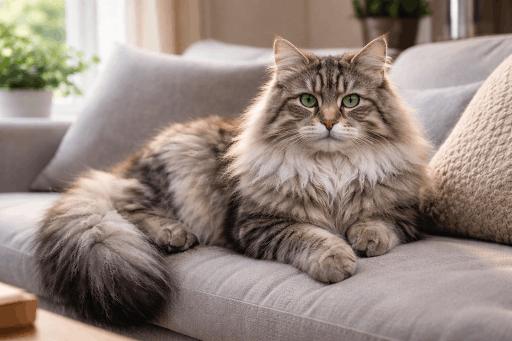
The Siberian cat did not emerge from a cattery; it came from history itself. Its ancestors slept on clay stoves in wooden huts, endured blizzards, and built their “business” on hunting mice. This is not merely a cat with a bushy tail. It is the Siberian cat—an embodiment of Russian fortitude, forged in a land where summer is simply a less severe winter. It is a whiskered bogatyr clad in a luxurious fur coat.
From Bukhara to Siberia: How the Cat Became a Cossack
The earliest written references date as far back as the 17th century, though they speak not of “Siberian” but of “Bukhara” cats. As if some Central Asian merchant, trading in silk, brought with him a few fluffy beauties who then found themselves amid frost and taiga and concluded: “Adaptation is necessary.” And adapt they did—so successfully that their descendants came to be known as Siberians.
The breed developed without sentimental human intervention; it was sculpted by nature itself. The harsh environment became the most rigorous breeder: survival favored the largest, the strongest, and the best-insulated. Thus emerged a cat that does not fear the Russian winter—indeed, one might imagine laughing at it.
Appearance: Deceptive Strength and a Regal Coat
Observe it closely. This is not a cat but a fortress on four legs. A muscular, medium-to-large body, a back slightly higher at the shoulders, and a firm, barrel-like abdomen. Males weigh from 6 to 9 kilograms, sometimes even up to 12. This is not fat—this is structural resilience.
The coat, however, is paramount. It is less “fur” than a strategic reserve of warmth. A three-layer system: long, coarse guard hairs that repel water, and an extraordinarily thick, wool-like undercoat. In winter it forms a splendid ruff and fluffy “trousers,” while in summer it sheds, leaving reminders of its former grandeur throughout the home. The ears are often adorned with lynx-like tufts, while thick fur between the pads of the feet serves as natural snowshoes.
The Siberian cat is frequently labeled hypoallergenic. There is no magic in this. The allergen is the Fel d 1 protein found in saliva and skin secretions. However, studies indicate that roughly half of Siberians produce lower levels of this protein compared to other breeds, and about 20% produce very little. Females tend to produce less than males. Therefore, there is a chance—though it is something of a Russian roulette. Only testing a specific kitten or its parents can provide a reliable answer.
The Temperament of the Siberian Cat
Do not be misled by its calm gaze. This is not a phlegmatic creature but an intellectual with excellent physical prowess. The Siberian matures slowly, reaching full adulthood at 3–5 years while retaining adolescent playfulness. It can leap onto a wardrobe seemingly effortlessly and then regard you from above with the composure of a Stoic contemplating a chaotic world.
It is devoted but not intrusive. It will follow you, take part in your daily affairs, yet occupy itself peacefully should you be busy. It senses the owner’s mood with remarkable precision. Within it coexist the independence of a wild predator and the tenderness of a domestic companion. Gentle with children, it rarely tolerates rough handling. It coexists well with other animals, though small rodents and birds are considered legitimate prey—its hunting instinct is in the blood.
Health and Longevity: The Siberian Reserve of Strength
Its natural origins bestowed the breed with robust health. These are feline long-livers, often surpassing 15–17 years, and sometimes reaching 20. Their immune resilience is the result of natural selection in an environment where only the strongest survived.
Yet even heroes have vulnerabilities. There is a genetic predisposition toward hypertrophic cardiomyopathy (a cardiac disease) and polycystic kidney disease. Responsible breeders screen their breeding animals for these conditions. Another common issue is hairballs in the stomach, given the breed’s luxuriant coat. The remedy: regular grooming and specialized pastes or diets.

Care: The Brush as Your Main Instrument
Living with a Siberian is a pact. You provide shelter, food, and affection, and in return you receive loyalty and aesthetic delight. In exchange, you must invest time in the maintenance of its coat.
Brushing is required 2–3 times per week, and daily during shedding periods (spring and autumn) lest mats form. Bathing is seldom necessary—their coat is nearly self-cleaning. Ear, teeth, and claw care are essential. So is space for movement. Ideally, a private home allowing safe outdoor exploration, though even in a flat the cat will find a way to climb—preferably onto a dedicated cat tree rather than your cherished cabinet.
Siberian cats may reach reproductive maturity as early as five months. Nature hurried, knowing how harsh life could be. The average litter consists of 5–6 kittens, more than many breeds. And yes, Siberian males are exemplary fathers, often assisting the female in caring for the offspring.
Instead of an Epilogue: Not a Pet, but a Heritage
The Siberian cat is not merely a breed. It is part of a cultural code, a living fairy tale that journeyed from Bukhara’s caravans through Siberian snowstorms to championship titles at international cat shows. It proves that true beauty and strength arise not in greenhouse conditions but in alliance with nature.
-
 Culinary RecipesEveryone’s Favorite Pancakes: an Interesting History and a Classic Recipe
A pancake lies on your plate—modest, golden, smelling of childhood and butter. Don’t be fooled. It’s one of the oldest gastronomic t...
23 Jan 2026, 11:24 -
 ReligionHoliday Prayer (Ṣalāt al-ʿĪd) in Islam: Structure, Symbolism, Significance
There arrives that singular dawn when the air seems to vibrate with quiet joy. Cities and villages still slumber, yet in Muslim homes lights begin to...
23 Jan 2026, 08:00 -
 ReligionBeginning the Day with Worship: On the Morning Prayer
Once, at the very break of dawn, when the world stood still in anticipation of the first ray of light, the Prophet Muḥammad (peace and blessings be up...
23 Jan 2026, 06:48