



How to Prepare a Child for School: An Honest Guide Without Rose-Colored Glasses
Let us be candid with one another. The race for an “elite” school, endless handwriting drills, and mental arithmetic up to one hundred is, more often than not, parental anxiety neatly packaged as “care for the future.&rdqu...

Author
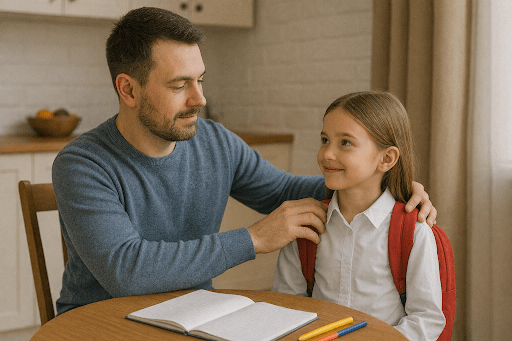
Let us be candid with one another. The race for an “elite” school, endless handwriting drills, and mental arithmetic up to one hundred is, more often than not, parental anxiety neatly packaged as “care for the future.” We act with the best intentions, yet the result is frequently a tense, anxious child who, by the age of seven, is already afraid of falling short.
Stop. Take a breath.
Preparing for school is not about reading or counting. These skills will be taught. It is about ensuring that September 1 becomes the beginning of a great adventure for your child, rather than a psychological trauma that lingers for years.
Real-life spoilers that hurt more than any theory
- Story No. 1.
Vasya, who at five could solve logic problems, burst into tears on his very first school day because he could not manage the “tricky” clasp on his backpack. His mathematical talent collapsed in the face of a basic everyday skill. - Story No. 2.
Masha, who had memorized the English alphabet, did not know how to walk up to another child and simply say, “Let’s be friends.” Her brilliant mind lost to a basic ability to communicate. - Story No. 3.
Artyom, who could not yet read, became the heart of the class because within five minutes he could reconcile conflicts and invent brilliant games. His secret weapon was emotional intelligence.
The conclusion?
School readiness is not the sum of accumulated knowledge. It is a sturdy backpack of skills that you help your child assemble—and what you put into it is not handwriting notebooks, but something far more important.
Foundation 1. Emotional Intelligence: the Most Important Subject Not on the Timetable
School is a long series of stresses, conflicts, resentments, and joys. A psychologically prepared child is not a robot, but a person who can manage emotions rather than suppress them.
What can you do?
- Abandon the trap question “How was school?” Instead ask: “What was the funniest thing today?”, “Who did you play with?”, “What upset you?”
- Teach your child to name emotions. “I see you’re angry,” “Are you disappointed?”, “It looks like you’re proud of yourself.” An emotion that is named aloud loses half of its destructive power.
- Play role-playing games. “Imagine you forgot your pencil case—what would you do?”, “What if someone teases you?” This is a safe training ground for real-life situations.
Remember, that a child who can say “I’m scared” or “I don’t understand” is better protected than one who has memorized every poem by heart.
Foundation 2. Soft Skills: More Important Than Handwriting
Paradoxically, it is these “soft skills” that turn a child into a confident first-grader rather than an exhausted overachiever.
Before September, focus especially on:
- Independence: dressing and undressing, cleaning up after breakfast, packing a backpack. This builds confidence when you are not nearby.
- Asking for help: approaching the teacher without embarrassment to say that they need the restroom or did not understand the task.
- Concentration: the ability to focus on one activity for 15–20 minutes—not through coercion, but through engagement. Sculpt, build, solve mazes together.
- Social intelligence: negotiating, sharing, saying “no,” joining a game. Courtyards and playgrounds are the best training grounds for this.
Foundation 3. Thinking, Not Rote Learning: Turn the Child’s Mind On
Here is the key insight that overturns everything: children will be taught to read, write, and count at school. Thinking properly, however, is not always taught.
Your task is not to provide knowledge, but to provide tools for acquiring it.
How can you “activate” thinking through play?
- Turn everyday life into a quest. “How many steps to the entrance?”, “Find all the round objects in the room,” “Sort the socks into pairs.”
- Develop logic. Riddles, puzzles, “find the odd one out” tasks, simple rebuses—these teach the brain to recognize patterns and connections.
- Eliminate fear of mistakes at the root. Repeat like a mantra: “A mistake is not a failure; it is a step forward. That is how we learn.” Praise effort, not only results.
Foundation 4. Parental Calm Is the Best Textbook
Your anxiety is a virus against which a child has no immunity. If you lose your temper over a crooked line in a notebook, the child concludes: “I’m not perfect, Mom is upset, I will be scolded.” School then becomes a battlefield, not a place of learning.
Your primary mission is to be a safe harbor.
- Slow down: do not demand perfection. A crooked letter is not a tragedy.
- Believe in your child: our faith in them functions like armor. They enter a new world full of challenges wearing it.
- Remember: you are not raising an honor student, but a human being—happy, confident, and capable of coping with difficulties.
School readiness is not about preparing notebooks; it is about preparing the mind, the heart, and the character. Put curiosity into your child’s backpack instead of fear of mistakes. Put faith in their abilities instead of inflated expectations. Then September 15 will not feel like judgment day, but like the beginning of the most exciting quest of their life.
We also strongly recommend browsing our notice board to choose the best school stationery!
-
 Culinary RecipesEveryone’s Favorite Pancakes: an Interesting History and a Classic Recipe
A pancake lies on your plate—modest, golden, smelling of childhood and butter. Don’t be fooled. It’s one of the oldest gastronomic t...
23 Jan 2026, 11:24 -
 ReligionHoliday Prayer (Ṣalāt al-ʿĪd) in Islam: Structure, Symbolism, Significance
There arrives that singular dawn when the air seems to vibrate with quiet joy. Cities and villages still slumber, yet in Muslim homes lights begin to...
23 Jan 2026, 08:00 -
 ReligionBeginning the Day with Worship: On the Morning Prayer
Once, at the very break of dawn, when the world stood still in anticipation of the first ray of light, the Prophet Muḥammad (peace and blessings be up...
23 Jan 2026, 06:48