



Multiply and Conquer: How to Learn the Times Table Without Losing Your Mind
Spoiler: memorizing it is much easier than you think. We’ve gathered the most effective methods—no tears, no mindless drilling, and no threats from your homeroom teacher. Only practical techniques tested by generations of studen...

Author
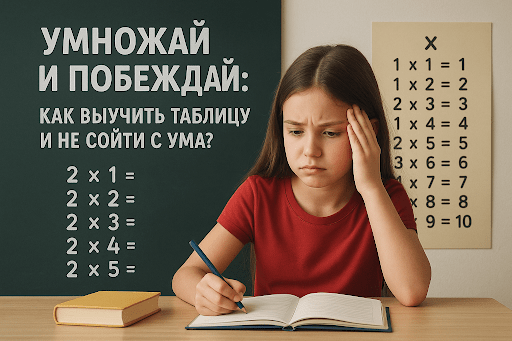
Spoiler: memorizing it is much easier than you think.
We’ve gathered the most effective methods—no tears, no mindless drilling, and no threats from your homeroom teacher. Only practical techniques tested by generations of students, Chinese schoolchildren, and top performers in Baku.
Seriously, the multiplication table is like a bicycle: at first you wobble, then you balance, and eventually you can ride hands-free. The key is finding your own learning path.
Here is what will actually help you (and none of it requires cramming under the fear of a failing grade):
1. Turn it into a game
Writing 7×8=56 a hundred times is unbearably dull—like being punished by counting cracks on the ceiling: tedious and pointless.
But playing? That’s an entirely different matter.
Play stimulates interest, engages imagination, and reduces anxiety. This is precisely why children worldwide learn better through game-based activities.
For example, in Baku schools such as Baku-Oxford School and Azerbaijan British College (ABC), mathematics is taught through games and interactive methods. They even have special apps and mini-tournaments dedicated to the multiplication table—students simply compete and enjoy the process instead of feeling stressed.
Try a “table battle”: make flashcards, lay them out, choose answers as fast as you can, and compete with someone. Create a scoring and bonus system. At this point, it’s no longer studying—it’s practically a board game. Whoever loses completes a fun challenge!
Useful apps for practice:
Toon Math, Math Fight, Times Tables Rock Stars, Multiplication Kids.
(Some even have Azerbaijani audio versions.)
Interestingly, one school in Baku even created “game stations”: each desk has its own mini-game with problems. A student completes all the stations and earns a multiplication “level-up.” Pure gamification.
2. Don’t learn everything at once—use blocks
Don’t force the entire table from 2 to 9 into your memory in one go. Break it into parts.
That’s precisely what many Baku lyceums do—for instance, Lyceum No. 134 introduces the basics first (2, 3, 4), then intermediate numbers (5, 6), and only after that the more difficult ones (7, 8, 9).
Universities such as Baku State University and the Azerbaijan State Pedagogical University also train future teachers to break complex material into smaller, manageable units. This is a classic, well-tested method.
This approach prevents memory overload and creates a sense of progress. After the first simple blocks, the brain gets used to the structure and the rest becomes easier.
And remember: even the world’s top math schools use block-based teaching. It’s no coincidence—it’s a deliberate strategy.
3. Use music and rhythm
Compose a multiplication rap!
If that’s too much effort, simply turn on existing songs: YouTube is full of videos where the times table is sung to a beat, performed like a musical, or turned into a catchy tune.
If you have strong visual-auditory memory, this method is especially effective.
A fascinating fact: in China, children have traditionally learned multiplication in rhyme since ancient times. It sounded like poetry. Children mastered it by age six—and the tradition continues today, helping Chinese students excel in math competitions.
And if you prefer Turkish or Azerbaijani music—try adapting the table to your favorite melody. Even if it sounds odd, your brain won’t mind; it will thank you.
4. Visualize everything
You won’t believe it, but sometimes simply seeing the table often is enough for it to settle into memory—like advertising: you don’t watch it intentionally, yet suddenly recall the slogan.
Print the table and make it visually appealing: colorful, illustrated, fun. Hang it on the door, wall, closet, refrigerator, mirror. Set it as your phone wallpaper—or even stick it on your phone case.
Every glance is another step toward mastery.
If you’re creative, draw your own table. Make a comic, collage, or theme it after Harry Potter or Naruto. The more personal it feels, the stronger the memory.
In Landau School and Dunya School (Baku), classrooms often feature bright multiplication posters with cartoon characters and memes to keep students engaged.
5. Use practical shortcuts
There are simple tricks that truly make mental multiplication easier:
- The nines trick: Bend the finger representing the multiplier. For 9×3, fold the third finger: you get 2 and 7 → 27.
- Multiplying by 2: Just add the number to itself.
Example: 4×2 = 4+4. - 6×4? Picture six cats with four paws each—24 paws. Imagery often beats numbers.
- Multiplying by 5: The result always ends in 0 or 5.
Fingers, music, rhythm—anything that helps is valid.
Professional-development courses at institutions like the Azerbaijan Teachers’ Institute and the Institute of Education of the Republic of Azerbaijan teach educators how to present such tricks so students never forget them.
A fun story: one student from Baku, who considered herself “a humanities person through and through,” learned the entire table by creating mini-stories for every pair of numbers.
For example:
“6×7 = 42 — like six friends, each with seven homework tasks: 42 tasks and one giant headache.”
That’s storytelling in action.
What if nothing is working? ☹
Remember this: you’re not the problem—the method is.
If memorization doesn’t work, try humor.
If humor doesn’t work, try visuals.
If visuals don’t work, try dancing, singing, memes, doodles, fridge stickers, palm flashcards…
You don’t have to learn like everyone else—you have to learn the way you find comfortable.
One boy wrote the table on balloons and popped the ones he had mastered. The other people practiced on the refrigerator and rewarded himself with a cookie for every correct answer.
If it works—it’s valid.
Find your style and start.
Some people learn with their eyes, others with their ears, others with their hands.
Some through TikTok, some through their grandmother’s chants.
There is no “one correct method.”
You don’t have to fit into someone else’s system.
The table is just 81 facts.
And you can learn them—not because you “must,” but because it can be easy, fun, and entirely stress-free.
The multiplication table is not a sentence. It’s not divine punishment. It’s simply 81 combinations, and you can master them. If not in one day, then in three; if not in three, then in a week. What matters is learning without fear and with humor. With these strategies, success is guaranteed.
The essential thing is to choose your own learning style: some learn with their eyes, some with their ears, some with their fingers. Start today!
Learning begins with small things. Want the table to stick faster? Choose bright markers, stickers, and study posters on our notice board!
-
 Culinary RecipesEveryone’s Favorite Pancakes: an Interesting History and a Classic Recipe
A pancake lies on your plate—modest, golden, smelling of childhood and butter. Don’t be fooled. It’s one of the oldest gastronomic t...
23 Jan 2026, 11:24 -
 ReligionHoliday Prayer (Ṣalāt al-ʿĪd) in Islam: Structure, Symbolism, Significance
There arrives that singular dawn when the air seems to vibrate with quiet joy. Cities and villages still slumber, yet in Muslim homes lights begin to...
23 Jan 2026, 08:00 -
 ReligionBeginning the Day with Worship: On the Morning Prayer
Once, at the very break of dawn, when the world stood still in anticipation of the first ray of light, the Prophet Muḥammad (peace and blessings be up...
23 Jan 2026, 06:48