



Love and Law: Contemporary Marriage Registration in Azerbaijan
Some couples seek to register their marriage as quickly as possible and occasionally resort to unexpected measures. One couple, for instance, submitted unconventional documents to the civil registry office in an attempt to expedite the proc...

Author
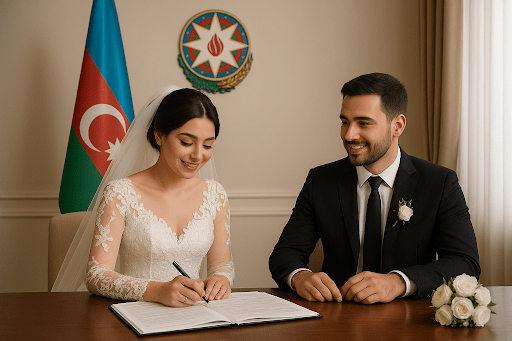
Some couples seek to register their marriage as quickly as possible and occasionally resort to unexpected measures. One couple, for instance, submitted unconventional documents to the civil registry office in an attempt to expedite the process. Another spent three full months obtaining their grandmother’s birth certificate in order to officially prove the absence of familial ties. A third embraced modern technology and registered their marriage via a smartphone application. Today, marriage registration in Azerbaijan has become a synthesis of tradition and digital innovation, where procedural order and technology proceed hand in hand.
Azerbaijan—a country of fire, carpets, and… marriages that can now be registered without leaving one’s sofa. The state seems finally to have grasped a simple truth: love does not wait, especially when one can drown in a sea of documents faster than in the Caspian Sea.
Spoilers from the courtroom (or rather, from the civil registry office):
- The numbers: marriage now costs 10 manats, requires 14 days for medical examinations, and one click in an application. Romantic? Indeed.
- The paradox: the simpler the procedure becomes, the fewer couples decide to take this step. Statistics quietly suggest a decline in marriages. Apparently, the last excuse—“we just never made it to the registry office”—has disappeared.
- The irony: to seal a union digitally, one must still complete a very real quest—medical examinations. The state safeguards your DNA while you plan your honeymoon.
Love in the Age of Digital Signatures
The era when marriage was a transaction between families, sealed with a cauldron of pilaf and loud folk melodies, has long passed. Today, the principal wedding coordinator is the “mygov” system, and the couple’s first dance begins with the movement of a thumb across a smartphone screen.
The procedure has become so straightforward that it may even seem offensive to admirers of bureaucratic epics.
Step 1: The Medical Examination, or “Love Must Be Healthy.”
Before algorithms approve your union, physicians must render their judgment. The mandatory medical examination resembles a final boss before the level entitled “Happy Family Life.” After 14 days, blood test results mysteriously appear in the system, and you receive digital approval. No envelopes with certificates—only cold bits and bytes confirming that you are a suitable match. From the state’s perspective, at least.
Step 2: A Digital Proposal of Marriage.
Open the “mygov” application. Navigate to “Life Events” → “Creating a Family.” It sounds like a quest in The Sims, does it not? One partner initiates the application; the system verifies your medical “achievements,” and then appears a screen with a personal identification number and a confirmation code. You forward this code to your partner. This is the modern equivalent of the question, “Will you marry me?”
If the code is entered, consider yourselves engaged—Azerbaijani-style.
Step 3: Surname, Payment, and 30 Days for Reflection.
You choose a shared surname (or retain your own—thank you, feminism), specify the ASAN service center or civil registry office where you wish to receive the coveted document, and pay the state fee—those same 10 manats (cheaper than a good bouquet of flowers). Then comes the most peculiar phase: a month-long waiting period. In that time, one can reconsider the decision countless times, quarrel over which curtains will hang in the living room, and reconcile again. Previously, this period was intended to “test one’s feelings.” Today, it serves to test the stability of one’s internet connection.
Step 4: Receiving the “Crystal” of Your Relationship.
After 30 days (or sooner, if there is a valid reason such as a business trip or pregnancy), the application courteously announces the status “Completed.” You visit the selected center and receive not merely a piece of paper, but a symbol—the marriage certificate. Its digital counterpart is permanently stored in your profile. That is all. You are officially “in the game.”
Can It Be Faster? Marriage at Short Notice
Life often intervenes. If waiting a month is impossible, the state is prepared to show understanding. The list of valid reasons for expedited registration reads like the script of a melodrama:
- A long-term business assignment (love does not wait while one tours oil fields).
- Military conscription (to marry before a loved one is called to defend the motherland).
In such cases, the marriage may be registered on the day of application. Bureaucracy yields to genuine feelings—or to a properly presented certificate.
Hidden Reefs in the Sea of Love
Yet not everything is smooth in the digital kingdom. New rules bring not only convenience, but also control.
- The Ban on Consanguineous Marriages.
From July 1, 2025, marriages between first cousins are officially prohibited in Azerbaijan. The state has entered the defense of the gene pool with superhero-like determination. The Ministry of Justice’s system will now verify your lineage. If it cannot do so, you will be asked to provide your parents’ birth certificates. Searching for these documents may become an engaging, albeit nerve-racking, genealogical investigation. “Are you certain you are not related?”—this question is now posed not by suspicious relatives, but by algorithms. - Marriage to a Foreigner.
Have you fallen in love with a citizen of another country? Wonderful. But if he or she is residing in Azerbaijan illegally, your marriage will not be registered. Love, it turns out, must be not only mutual, but also lawful. The application must include a copy of a document confirming the partner’s legal stay. Romance thus encounters the migration service.
Offline Is Still in Fashion
Digitalization has not sentenced traditionalists to extinction. The classic route through the civil registry office, ASAN service center, or a consulate (for Azerbaijani citizens abroad) remains available.
You will still need:
- Passports.
- A certificate confirming the absence of an existing marriage (which sometimes seems the most important document in one’s life).
- The same medical certificates (which may also be submitted in paper form).
- Two witnesses (so that someone can later recount how nervous you were).
And yes, marriages are still registered in a ceremonial setting. No technology can replace trembling knees and that singular moment when you are declared husband and wife.
The Contest Between Tradition and Technology
So how should one register a marriage in Azerbaijan? The answer depends on you.
Choose between a swift digital union concluded between two smartphones, or a solemn ritual involving a visit to a wedding palace.
Azerbaijan has placed its bet on progress, seeking to simplify one of the most significant processes in a person’s life. The “mygov” application represents an attempt to inscribe a millennia-old tradition into a new digital landscape. Will it succeed? Statistics remain silent for now. But one thing is certain: a love that has endured medical examinations, the “mygov” system, and the search for great-grandmothers’ birth certificates is a love worth having.
In the end, what matters most is not how you registered your marriage, but how you live it—even if it began with a confirmation code in an application.
-
 Culinary RecipesEveryone’s Favorite Pancakes: an Interesting History and a Classic Recipe
A pancake lies on your plate—modest, golden, smelling of childhood and butter. Don’t be fooled. It’s one of the oldest gastronomic t...
23 Jan 2026, 11:24 -
 ReligionHoliday Prayer (Ṣalāt al-ʿĪd) in Islam: Structure, Symbolism, Significance
There arrives that singular dawn when the air seems to vibrate with quiet joy. Cities and villages still slumber, yet in Muslim homes lights begin to...
23 Jan 2026, 08:00 -
 ReligionBeginning the Day with Worship: On the Morning Prayer
Once, at the very break of dawn, when the world stood still in anticipation of the first ray of light, the Prophet Muḥammad (peace and blessings be up...
23 Jan 2026, 06:48