



Novruz: The Four Elements Awaken Spring
This day arrives quietly yet inevitably. It is not bound to numbers on a calendar, but follows a higher law — the law of the Sun. At the moment of the spring equinox, when light and darkness, day and night pause in perfect balance, No...

Author
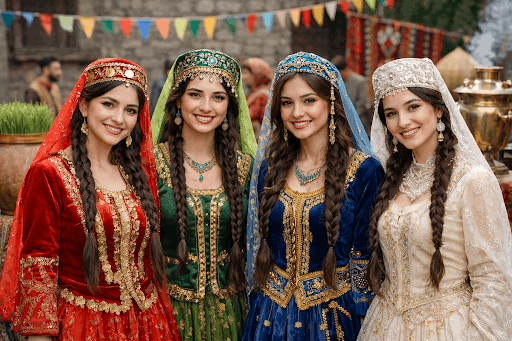
This day arrives quietly yet inevitably. It is not bound to numbers on a calendar, but follows a higher law — the law of the Sun. At the moment of the spring equinox, when light and darkness, day and night pause in perfect balance, Novruz begins.
Its history is measured not in centuries, but in millennia. Scholars speak of an age of 3,700 — or perhaps even 5,000 — years. Its roots stretch back to the era of Zoroastrianism, to the times of the mighty Achaemenids, when shahanshahs received gifts from conquered peoples. It is a holiday that has outlived empires and changes of religion, because its essence lies deeper than any ideology. It celebrates what is most fundamental: the triumph of life over stillness, light over darkness, warmth over cold.
Today, Novruz is observed by more than 300 million people from the Balkans to Eastern Turkestan. And since 2010, March 21 has been recognized as the International Day of Novruz by the United Nations. Yet for everyone who awaits it, Novruz is first and foremost a personal story — a story of return.
Four Tuesdays, Four Elements: A Countdown
In Azerbaijan one does not merely “prepare” for Novruz — one senses it with the whole being. A month before the main day begins a mystical journey through four Tuesdays and four primary elements.
First comes Su Çərşənbə — the Tuesday of Water. On this day, water is believed to renew itself and come into motion. Leaping across a stream or washing with spring water symbolizes cleansing oneself of the misfortunes of the past year.
Next comes Odlu Çərşənbə, the Tuesday of Fire. At dusk, bonfires flare in courtyards and on hilltops. Everyone — young and old — jumps over them seven times, reciting: “My pallor to you, your redness to me.” Here fire does not destroy — it purifies, burning away all that winter has burdened the soul with. The extinguished fire is not doused with water; its ashes are carried away from the home, taking misfortune with them.
The third Tuesday is Torpaq Çərşənbə, the day of Earth. The soil awakens from its slumber.
The cycle concludes with Axır Çərşənbə, the final pre-festive Wednesday. It is the night of wind, of rites, divinations, and secrets. Girls divine their future husbands by tossing a shoe over the shoulder or eavesdropping at neighbors’ doors. Every household lights candles — one for each family member — and these flames must not be extinguished; they are left to burn out on their own.
Semeni, the Green Heart of the Holiday
In the corner of every home, a small miracle takes place. On a plate wrapped in damp cloth, a handful of wheat begins to sprout. This is səməni — the chief symbol of Novruz, embodying fertility, abundance, and life itself. One cannot buy it; it must be grown by hand, tended with care, and serenaded with an ancient rhyme: “Semeni, keep me safe; every year I shall raise you.”
By the holiday, it becomes a lush carpet of green shoots, tied with a red ribbon and placed in honor on the festive table. It forms a bridge between past and future, between humankind and the earth.
The Festive Table: A Miniature Universe
The table must contain seven foods whose names begin with the Azerbaijani letter “s” (sin): səməni (sprouted wheat), sumakh (sumac), süd (milk), sirkə (vinegar), səbzi (greens), among others.
The main accents, however, are the sweets — each representing a celestial body. Şəkərbura, crescent-shaped with a pine-needle pattern, stands for the Moon. The round, golden qoğal, sprinkled with caraway seeds, symbolizes the Sun. Paxlava, cut into diamond shapes, becomes the stars in the sky. It is said that the famed traveler Thor Heyerdahl, gazing at such a table, once remarked that it resembled a model of the universe.
Beside the sweets lie painted eggs, candles, and a mirror. An egg placed upon the mirror is an ancient way to determine the exact moment of the New Year’s arrival: when it sways, it means that the cosmic Bull has turned the Earth — and celebration may begin.

The Day When Doors Are Not Locked
On Novruz itself, March 21, people rise early. They wear something new. The doors of homes are left unlocked — a sign that the family is present and welcomes guests. There is even a saying: “If on the first day of Novruz you are not at home, for seven years you shall not see your home.”
Children laugh as they run through the streets, leaving caps or small sacks at neighbors’ thresholds. The neighbors fill them with sweets and nuts. It is more than a game — it is an ancient ritual of exchanging gifts and wishing goodness.
Throughout the day, the songs of ashiqs are heard, pehlivans compete in strength, and traditional plays are performed — the most famous being “Kös-Kösa,” featuring the characters Kosa (the Red-bearded) and Kechal (the Bald One). When evening falls, great communal bonfires illuminate the night, and people dance in circles around them.
A Holiday Beloved by Azerbaijanis
Novruz is a celebration of nature, family, purity, and hope. It teaches simple yet eternal truths: reconcile with those you have quarreled with, bring order to your home and soul, help those in need, and give thanks to your loved ones.
In Azerbaijan, Novruz is welcomed with an open heart, a generous table, and a quiet faith that after the longest winter, spring will always come. And this ancient, wise holiday — having outlived the ages — reminds us each time of the most important law of life.
-
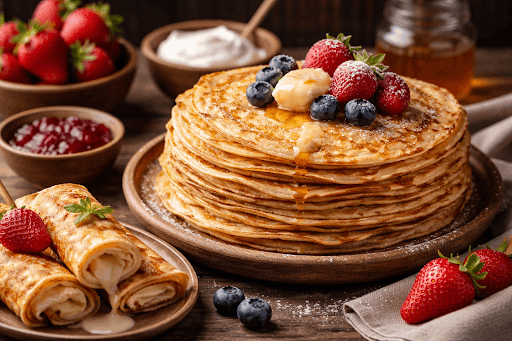 Culinary RecipesEveryone’s Favorite Pancakes: an Interesting History and a Classic Recipe
A pancake lies on your plate—modest, golden, smelling of childhood and butter. Don’t be fooled. It’s one of the oldest gastronomic t...
23 Jan 2026, 11:24 -
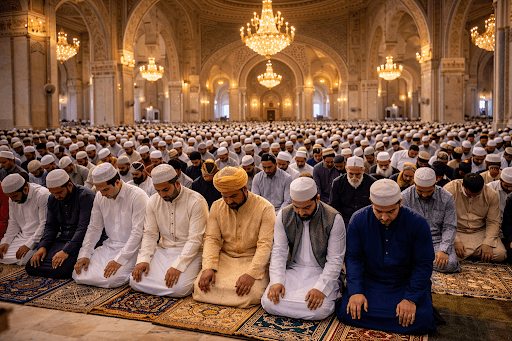 ReligionHoliday Prayer (Ṣalāt al-ʿĪd) in Islam: Structure, Symbolism, Significance
There arrives that singular dawn when the air seems to vibrate with quiet joy. Cities and villages still slumber, yet in Muslim homes lights begin to...
23 Jan 2026, 08:00 -
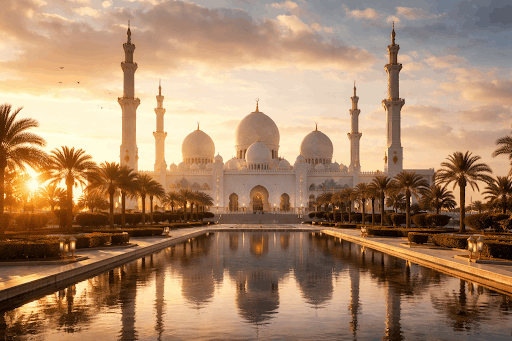 ReligionBeginning the Day with Worship: On the Morning Prayer
Once, at the very break of dawn, when the world stood still in anticipation of the first ray of light, the Prophet Muḥammad (peace and blessings be up...
23 Jan 2026, 06:48