



“Mimosa Salad: From Soviet Classic to Contemporary Variants”
People named this salad after a flower—one many had only ever seen on postcards. It was assembled from tins, queues, and shortages, from that bittersweet lexicon of “we managed to get it” and “we were lucky.” I...

Author
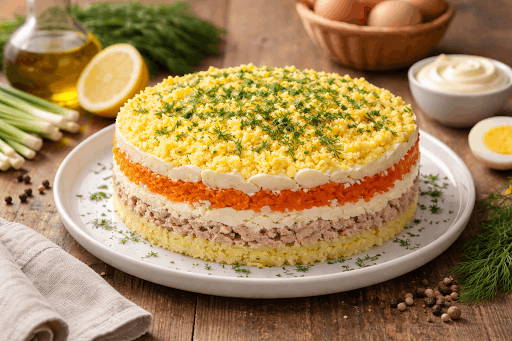
People named this salad after a flower—one many had only ever seen on postcards. It was assembled from tins, queues, and shortages, from that bittersweet lexicon of “we managed to get it” and “we were lucky.” In the end, it fed not merely guests, but an entire era.
This is more than a recipe. It is a layered novella about small victories and large disappointments. A dish that became a symbol of spring in a country where even the seasons seemed to operate according to official regulations.
Above all, it was beloved by Soviet women: those who could conjure a celebration out of nothing, beauty out of canned goods, and from an ordinary table the sensation of a grand occasion.
It was a salad that smelled not of fish and mayonnaise, but of hope, the 8th of March, and the quiet happiness of a kitchen in bloom.
Part I: A Flower in a Tin Can
Its history begins with two mutually exclusive facts.
Fact One, Soviet: Mimosa salad is a child of the stagnation era. Early 1970s, USSR. According to rumor, it was invented in the resort town of Gagra to impress holidaymakers at sanatoria.
The ingredients were basic yet festive: a tin of canned fish (pink salmon, Pacific saury, tuna), a dozen eggs, an onion, a block of butter, a hunk of “Soviet”-style hard cheese, and of course mayonnaise—the principal adhesive sauce of the era. Everything was finely grated, minced, or mashed, then layered with austere precision into something distantly resembling the fluffy yellow bloom of a mimosa.
The recipe was published in Rabotnitsa magazine and the newspaper Trud, after which every second homemaker prepared it for International Women’s Day on March 8. Simple, inexpensive, impressive.
Insider Note #1: Ten Commandments on a Plate
The classic Soviet Mimosa was not chaos but architecture: ten layers, like ten commandments, violation of which was considered mauvais ton.
The canonical order: 1) egg whites, 2) cheese, 3) half the fish, 4) mayonnaise, 5) grated frozen butter, 6) onion, 7) remaining fish, 8) mayonnaise, 9) yolks, 10) herbs for appearance.
There was no potato or carrot in the original. Those were additions of the hungry 1990s, born of the need to feed more mouths with fewer rubles. Rice also arrived in that decade—not for subtlety but for satiety.
Fact Two, French: Mimosa salad is in fact an aristocrat with pedigree. In France, mimosa denotes a salad of leafy greens, cucumbers, and peas dressed with vinaigrette and generously dusted with crumbled hard-boiled egg yolk. Its yellow-green palette echoes the spring flower.
The recipe has been known since the 19th century. There is also œufs mimosa—stuffed eggs, a familiar Parisian hors d’oeuvre. No canned fish, no onions, certainly no mountains of mayonnaise.
So who borrowed from whom? The French with their refined greenery, or Soviet citizens with their cult of tinned fish and mayo? As usual, the truth lies somewhere in between. Most likely it was a coincidence of aesthetics—the crumbled yolk really does resemble blossoms. Combining it with canned fish and mayonnaise, however, was a distinctly Soviet culinary performance, ingenious in its simplicity.
Part II: Anatomy of a Cult
To understand the phenomenon of Mimosa, one must first understand its time.
- Accessibility: all ingredients—except perhaps for canned red salmon—could be found in any household. Eggs, onions, butter, cheese. There was scarcity, yes, but for holidays one “pulled strings.”
- Effect: against the backdrop of total product minimalism, a layered salad with such a poetic name appeared as a spaceship next to mashed potatoes. It was a holiday served on a plate.
- Simplicity: no need to be a chef. Grate, mash, layer, spread. Culinary success was guaranteed even at zero skill level.
- Symbolism: the yellow crumbles evoked mimosa—the quintessential flower of the 8th of March. The salad became an edible bouquet, a tribute to women. Ironically, it was usually they who prepared it.
Health benefits? Let us not indulge in illusions. It is a caloric bomb of fats (mayonnaise, butter, yolks) and canned goods. Yes, the fish brings omega-3s, the eggs protein, and if you added potatoes you gained some potassium. But no one ate Mimosa for health. They ate it for happiness—fleeting, like the fragrance of that very flower.

Part III: Recipe Chaos
Today, Mimosa is no longer a recipe but a construction set. Every family now guards its own immutable truth.
Variant A. Canonical (from Trud)
Ingredients: 1 tin of canned salmon or pink salmon, 5 eggs, 100 g Russian-style hard cheese, 100 g butter, 1 onion, 200 g mayonnaise.
Method: Boil and cool the eggs. Grate the whites and cheese. Freeze and grate the butter. Finely chop the onion (you may briefly scald it). Mash the fish. Assemble in layers as above. Let it rest in the refrigerator for 3–4 hours.
Key trick: frozen butter melts inside the salad, making it tender rather than greasy.
Variant B. Popular (with potatoes and carrots)
The version everyone knows. Add 2–3 boiled potatoes and 1–2 carrots.
Layers: potatoes, fish with onion, carrots, whites, yolks. No cheese or butter here—heartier, more democratic, and familiar.
Variant C. Upgraded (for the unafraid)
Replace canned fish with lightly salted salmon or even smoked mackerel. Substitute store-bought mayonnaise with homemade or a mayonnaise–yogurt blend. Add some apples for acidity or capers for brine. Serve it in individual glasses—elegant and modern.
Fun number: a classic 10-layer Mimosa contains about 1500–2000 calories per dish. Divide among eight guests and you obtain a portion after which dinner becomes optional. Or don’t divide. It’s your holiday.
Part IV: Decline and Second Wind
Today Mimosa is no longer the protagonist of the festive table. Tiramisu, tartare, and burrata jostle it aside. It is criticized for heaviness, mayonnaise, and its “Sovietness.” Yet that is exactly what renders it a living legend. It is culinary nostalgia, a connective tissue between generations.
Preparing it now is not an act of mindless tradition but an ironic bow to the past—with a measure of respect and a pinch of contemporary interpretation. Use good ingredients, go easy on the mayonnaise, present it beautifully.
The salad in a tin survived. It outlived shortages, perestroika, and the invasion of fusion cuisine. Because in its layers there are not only fish and eggs. There are layers of a common history—layers one occasionally wishes to recall. To understand where we came from. And to consume that knowledge. Gently, like the petals of a mimosa.
-
 Culinary RecipesEveryone’s Favorite Pancakes: an Interesting History and a Classic Recipe
A pancake lies on your plate—modest, golden, smelling of childhood and butter. Don’t be fooled. It’s one of the oldest gastronomic t...
23 Jan 2026, 11:24 -
 ReligionHoliday Prayer (Ṣalāt al-ʿĪd) in Islam: Structure, Symbolism, Significance
There arrives that singular dawn when the air seems to vibrate with quiet joy. Cities and villages still slumber, yet in Muslim homes lights begin to...
23 Jan 2026, 08:00 -
 ReligionBeginning the Day with Worship: On the Morning Prayer
Once, at the very break of dawn, when the world stood still in anticipation of the first ray of light, the Prophet Muḥammad (peace and blessings be up...
23 Jan 2026, 06:48